Table of Contents
Every year thousands of Indian students search the same question before applying abroad: is NEET compulsory for MBBS in Russia? The confusion is understandable — Russian medical universities themselves do not ask for a NEET scorecard at admission. But that is only half the story, and the missing half is exactly where students get burned.
This guide explains what the National Medical Commission (NMC) actually requires in 2026, the difference between qualifying NEET and a rank-based cutoff, and what really happens to your career if you skip NEET and study anyway.
Short Answer: Yes — And Why
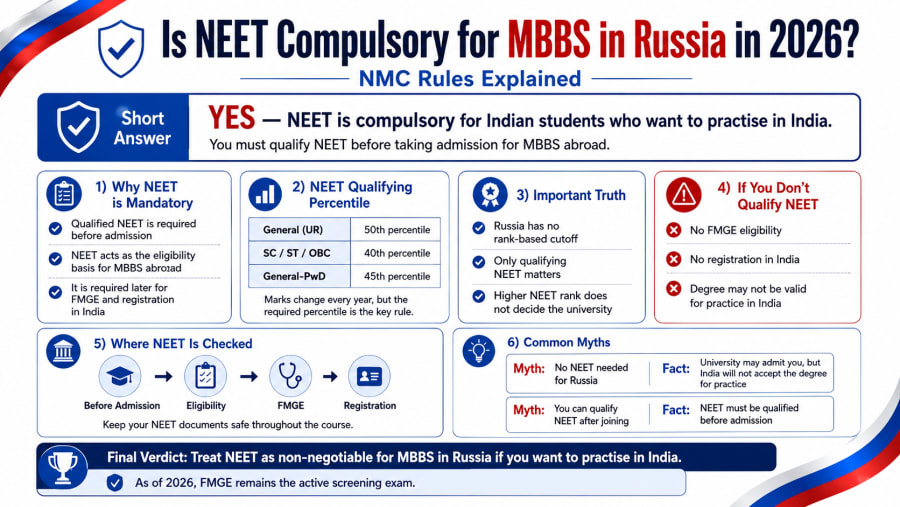
Yes, NEET is compulsory for MBBS in Russia in 2026 for any Indian student who intends to return and practise medicine in India. You must have a valid, qualified NEET-UG result before you take admission. Without it you can physically enrol in some Russian universities, but in NMC's eyes you were never eligible — so later you cannot obtain the NMC Eligibility Certificate required to sit the FMGE licensing exam or register with a State Medical Council back home.
In plain terms: the Russian university may accept you without NEET, but India will not accept your degree unless you had qualified NEET before starting the course. Treat NEET as a non-negotiable, not a formality.
Why NEET Is Mandatory for MBBS Abroad
The requirement comes from the NMC's framework for foreign medical graduates — the Eligibility Certificate rules (under which, since June 2019, a qualified NEET result is itself treated as your eligibility certificate to study abroad) together with the Foreign Medical Graduate Licentiate (FMGL) Regulations, 2021 that decide whether your degree is valid for registration in India. In practice this framework makes three things clear:
- ›Qualified NEET-UG before admission: you must have appeared for and qualified NEET before you take admission in the foreign medical college — not after joining.
- ›NEET is your eligibility certificate: since June 2019 a qualified NEET result is deemed to be the eligibility certificate for studying abroad — there is no separate pre-departure certificate to apply for.
- ›FMGE / NExT screening: after graduating you must clear the Foreign Medical Graduate Examination (FMGE), then do provisional registration and a 12-month internship in India before permanent registration.
So NEET is not a Russia-specific rule at all — it applies whether you go to Russia, Georgia, Kazakhstan, Kyrgyzstan or Uzbekistan. It is an India-side gate, enforced when you come back to work as a doctor.
Note: As of 2026, FMGE is still the active screening exam. The NExT (National Exit Test) has been formally deferred by the NMC and pushed back repeatedly since — in October 2025 the NMC signalled a further delay of around 3–4 years with trial mock tests first — so currently enrolled abroad students still sit FMGE. Always verify the latest NMC notification, since these timelines shift.
NEET Qualifying Percentile by Category
For MBBS abroad you only need to qualify NEET — meaning score at or above the minimum qualifying percentile for your category. You do not need a competitive rank. The standard qualifying percentiles are:
| Category | Qualifying Percentile | What It Means |
|---|---|---|
| General (UR) | 50th percentile | Top half of NEET candidates |
| SC / ST / OBC | 40th percentile | Relaxed reserved-category cutoff |
| General-PwD | 45th percentile | Persons with benchmark disability |
Note: These percentiles are the long-standing norms set out in the Graduate Medical Education Regulations and restated each year in the NEET information bulletin, but NMC/NBE can revise them for a given year (there have been past exceptions). The percentile is fixed; the actual marks needed to hit it change every year with paper difficulty. Always confirm the current-year qualifying cutoff from the official NTA NEET portal before you rely on it.
Qualifying vs Rank: Russia Has No Rank Cutoff
This is the single most misunderstood point. For an Indian government MBBS seat you need a high NEET rank and you go through counselling. For MBBS in Russia, there is no rank-based cutoff and no counselling — you simply need to have qualified. A student sitting near the qualifying line is just as eligible for Russia as a top-ranker.
| Basis | Indian Govt Seat | MBBS in Russia |
|---|---|---|
| NEET requirement | Qualify + high rank | Qualify only |
| Selection method | MCC/State counselling | Direct university admission |
| Rank-based cutoff | Yes — very competitive | No cutoff |
| Seats decided by | Merit + reservation | University intake capacity |
This is precisely why lakhs of NEET-qualified students who miss the Indian government cutoff choose Russia — the degree route stays open as long as NEET was qualified. See our detailed MBBS Russia vs India comparison for the full cost and outcome picture.
What Happens If You Don't Qualify NEET
Some agents will tell you a Russian university is "ready to take you without NEET." Technically the university might. But here is the chain of consequences on the India side:
- !No eligibility on record: a qualified NEET result taken before admission is what makes you eligible in NMC's eyes (it serves as your eligibility certificate). Skip NEET and nothing certifies you were entitled to study abroad.
- !Barred from FMGE: when you return, you must obtain the NMC Eligibility Certificate to sit FMGE — and that requires proof you qualified NEET before admission. No NEET, no FMGE attempt.
- !No registration in India: you cannot register with any State Medical Council or the NMC, so you legally cannot practise as a doctor in India.
- !Wasted years and fees: a full MBBS abroad that cannot be converted into an Indian licence is one of the most expensive mistakes a family can make.
The only students for whom this may not matter are those who genuinely never intend to practise in India — but even then, other countries have their own screening exams. For an Indian aspirant, plan as if NEET is mandatory, because for your India career it is.
Where NEET Is Checked in the Process
NEET does not get checked at one desk — it surfaces at several stages of your journey. Knowing where helps you keep documents ready and avoid last-minute panic.
Before You Leave India
- NEET scorecard for university application
- NEET result = your deemed eligibility certificate
- Student visa / documentation file
When You Return
- NMC Eligibility Certificate (to sit FMGE)
- Provisional / permanent registration
- 12-month internship in India
Keep your NEET scorecard, admit card and result printout safe for the entire duration of your MBBS. You will need to produce them years later at FMGE and registration stage. Not sure whether you qualify this year? Test your NEET readiness before you commit.
Note: The post-return steps — the NMC Eligibility Certificate application window, FMGE registration, provisional registration and the internship rules — are notified by NMC and NBEMS and can change between sessions. Confirm the current process and dates on the official NMC and NBEMS portals when you reach that stage, rather than relying on what applied to an earlier batch.
Common Myths (The "No NEET" Trap)
A lot of misinformation circulates in the abroad-admission market. Here are the claims you should treat as red flags:
- !"No NEET needed for Russia." Misleading — the university may skip it, but India will block your licence. NEET is compulsory for your India career.
- !"You can give NEET after joining." False — FMGL-2021 requires NEET to be qualified before admission, not after.
- !"A higher NEET score gets you a better Russian university." False — Russia has no rank cutoff; your score does not decide the university.
- !"The university is NMC-approved so NEET is optional." False on two counts — NMC does not pre-approve individual universities, and NEET is a separate student-side requirement.
On that last point: "NMC-approved university" is marketing language. NMC does not certify foreign colleges in advance — post-2021 it publishes no approved-universities list and judges each graduate against the rules. What matters is that the university is listed in the World Directory of Medical Schools (WDOMS) and your course meets FMGL-2021 conditions: the entire course of at least 54 months plus a 12-month internship at the same foreign institution, English medium of instruction, and a degree that lets you practise medicine in that country on par with its own citizens. Read our honest breakdown of NMC-approved universities in Russia and the wider NMC rules for MBBS abroad.
Final Verdict — Treat NEET as Non-Negotiable
For any Indian student planning to practise in India, NEET is compulsory for MBBS in Russia in 2026. You only need to qualify — no rank, no counselling — but that qualified result is the foundation your entire India licensing pathway rests on. Skip it and the degree becomes unusable back home, no matter how good the university.
Qualify NEET, choose a WDOMS-listed university that meets FMGL-2021 conditions, and keep your NEET documents safe for the full course. Rules and cutoffs can change yearly, so verify the current NMC notification before you apply — or get a verified university shortlist matched to your eligibility.
Share this article