The short answer
Stavropol State Medical University (StGMU) is a public federal medical university in southern Russia, run by the Russian Ministry of Health. It is listed in the World Directory of Medical Schools and has taught international students since 1961. Its English-medium General Medicine programme runs 6 years. The latest fee structure — set by the university's own signed order № 381-ОД of 23 April 2026 for the 2026-27 session — puts tuition at ₽285,000 per year, roughly US$3,400. Most pages still quote ₽235,000, which is last year's rate.
Its FMGE record is the number you should weigh hardest: across every NBEMS institute-wise report from 2012 to 2025, 789 of 6,194 candidates passed — 12.74%. That is below the Russian average. This page shows you the whole table rather than the one good year.
Search this university's name and you will get forty near-identical pages quoting ₽235,000 tuition, "WHO approved", "NMC approved" and a pass rate with no denominator. Three of those four are wrong, and the fee is a year out of date.
So this page is built differently. Every figure below was pulled from a primary document — the university's own signed fee order, the NBEMS performance report PDFs, the World Directory record — and each one is linked in the sentence that uses it. Where a document contradicts what agents publish, we say so and show you the document.
The verified basics
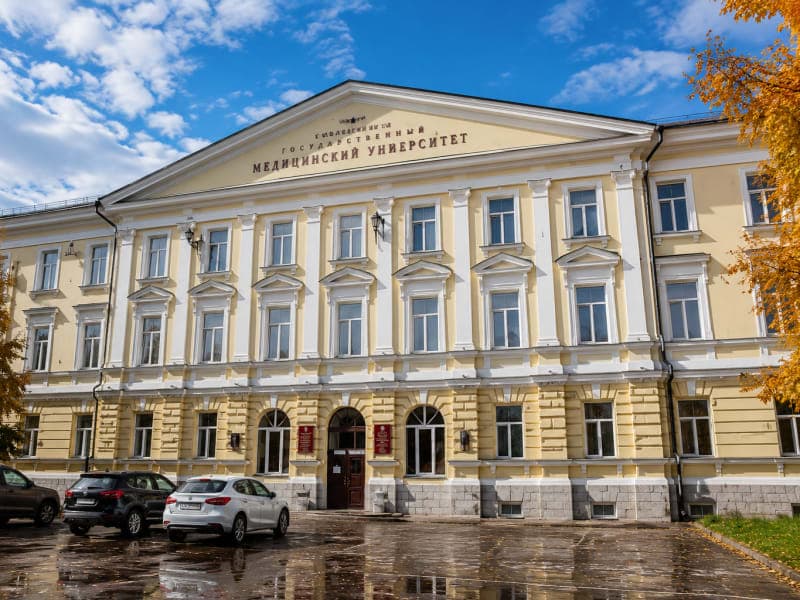
The full legal name is Ставропольский государственный медицинский университет — a federal state budgetary institution under the Russian Ministry of Health, based at Mira Street 310, Stavropol, in the North Caucasus. The rector is Viktor Nikolaevich Mazharov. Its official information sheet for foreign applicants gives the founding year as 1938, while the World Directory of Medical Schools records instruction as having started in 1937 — the year of the founding decree. Both dates are defensible; pages claiming anything else are guessing.
| Item | Verified detail |
|---|---|
| Type | Public, federal — Ministry of Health of the Russian Federation |
| Total students | About 8,000 across all faculties |
| International students | Over 1,000 from 35 countries, India included |
| Teaching foreigners since | 1961 — over 3,500 graduates for 90+ countries |
| Course for Indians | 31.05.01 Лечебное дело (General Medicine), 6 years |
| English medium | Available for General Medicine only — not Pediatrics or Dentistry |
| WDOMS / FAIMER ID | F0001020 — listed, currently operational |
That English-medium line deserves emphasis, because it is the single most misreported fact about this university. The official document's exact wording is that "Specialty of General Medicine may include training in an intermediary language (English)" — the Russian original calls it обучение на языке-посреднике. English is offered as a medium of instruction for the MBBS-equivalent course. It is not offered for Pediatrics or Dentistry, whatever a brochure tells you. Russian language study runs alongside it throughout, which is not a formality — you cannot take a patient history on a ward round in Stavropol in English.
Latest fee structure: official 2026-27 tuition, from the signed order
This is the latest fee structure published by Stavropol State Medical University, and it is current as of 14 August 2026. Russian state universities are legally required to publish tuition as a signed rectoral order, so there is no guesswork involved. StGMU's order for the 2026-27 academic year is № 381-ОД, dated 23 April 2026, and the rates for foreign citizens sit in Appendix 6. You can read the order yourself on the university's mandatory disclosure page. These are the latest numbers:
| Programme | Russian medium | English medium |
|---|---|---|
| General Medicine (31.05.01) | ₽275,000 | ₽285,000 |
| Pediatrics (31.05.02) | ₽275,000 | ₽285,000 |
| Dentistry (31.05.03) | ₽357,000 | ₽370,000 |
So under the latest fee structure, an Indian student on the English-medium General Medicine course pays ₽285,000 for the first year. At the mid-market rate in mid-August 2026 of roughly ₽84 to the US dollar, that is about US$3,400. The university's own prospectus separately prices a hostel place at ₽24,107 for the year.
Now compare that with what almost every other page about this university still shows. They quote ₽235,000. That figure was real — it is the 2025 rate, printed in the same prospectus that carries the hostel price, marked in a footnote as "the cost is given for the aggregate of 2025". It was superseded in April 2026. Tuition rose by ₽50,000, a little over 21%, and the same footnote warns that the university may index fees to inflation. A page still showing ₽235,000 is not lying to you on purpose; it simply has not been updated in a year.
That is the whole reason this section exists. If you are searching for the latest Stavropol State Medical University fees, the test of whether a page is current is simple: it should name the order number and date the fee comes from. This one does — order 381-ОД of 23 April 2026, for the 2026-27 academic year. We re-check it against the university's disclosure page each admission cycle and update this page when the order changes, rather than leaving last year's number in place.
Note
Every fee on this page is volatile in two directions at once. The university reprices in roubles each spring by rectoral order, and the rouble-rupee rate moves independently — so your cost in rupees can change even in a year when tuition does not. The figures above are what order 381-ОД sets for 2026-27; treat them as a reference point, not a quote.
Tuition is also only one line of the total. Hostel, medical insurance, visa and migration registration, nostrification of your certificate, and travel all sit outside it. For a full breakdown in your own currency, contact us for an exact quote before you budget anything.
The complete FMGE record, 2012-2025
Your degree from any foreign medical school is worth nothing in India until you clear the Foreign Medical Graduate Examination. So a university's FMGE record is the most decision-relevant number about it — and it is the number the industry is least honest about, usually by quoting one strong year with no denominator attached.
Here is every institute-wise report the National Board of Examinations in Medical Sciences publishes, from the first consolidated 2012-14 report to the most recent 2025 one. Nothing is averaged away and nothing is dropped.
| NBEMS report | Appeared | Passed | Pass rate |
|---|---|---|---|
| 2012-14 | 859 | 155 | 18.04% |
| 2015-18 | 1,423 | 137 | 9.63% |
| 2019 | 392 | 52 | 13.27% |
| 2020 | 436 | 43 | 9.86% |
| 2021 | 472 | 62 | 13.14% |
| 2022 | 548 | 70 | 12.77% |
| 2023 | 623 | 51 | 8.19% |
| 2024 | 719 | 132 | 18.36% |
| 2025 | 722 | 87 | 12.05% |
| All reports | 6,194 | 789 | 12.74% |
Two things about that table are worth explaining, because they are exactly where other sites go wrong.
- ›The 2015-18 report lists the university twice — once as "Stavropol State Medical Academy" (1,010 appeared, 66 passed) and once as "Stavropol State Medical University" (413 appeared, 71 passed). Those are the same institution: it held academy status from 1994 and became a university on 18 February 2013, so candidates in that window held certificates in both names. WDOMS confirms the link, listing "Stavropol State Medical Academy" among the school's alternate names. We have added the two rows together. Anyone reading only the second line will report a flattering 17.19% for a period whose real rate was 9.63%.
- ›2024 was a genuinely strong year at 18.36%, and it is the year you will see quoted alone. 2025 fell back to 12.05%. Within 2025 the two sittings also diverged sharply — 27 of 321 in June (8.41%), 60 of 401 in December (14.96%). One session is not a trend.
Set against its Russian peers, StGMU sits in the lower half. Across both 2025 sessions, Perm returned 201 of 826 and Kazan 107 of 387, both comfortably above Stavropol's 87 of 722. Sechenov, often assumed to be the safe premium option, passed 8 of 59 (13.56%), well below Perm and Kazan and only a little above Stavropol's 12.05%. We publish the same table for every university we work with on our FMGE pass rates hub, including the ones where the comparison does not flatter us, because a consultancy that only shows you its good numbers is not showing you numbers at all.
Note
FMGE results are republished by NBEMS after every session, so these rates move twice a year. They also describe cohorts who enrolled six or more years ago, under different teaching and different exam patterns — a 2025 pass rate tells you about students who started around 2019. Always check the current report before you rely on any figure here.
The honest reading of this table is not that StGMU is a poor university. It is that a Russian medical degree does not clear FMGE by itself anywhere, at any university — fewer than one in four of all FMGE candidates passed in either 2025 session (6,709 of 36,037 in June, 10,264 of 42,868 in December). What moves your odds is structured exam preparation running alongside the degree, from early years rather than a panicked six months at the end. StGMU's own prospectus says it trains foreign students for the screening test on campus, with "lectures delivered by professors from universities in India", both in person and online. Ask to see the current timetable for that, not just a mention of it. We also run A.J Medical Academy, which offers a dedicated FMGE programme for exactly this reason.
Recognition: what is verifiable, what is invented
This is the section where most pages about StGMU stop being factual. Three claims get repeated everywhere, and all three are false as written.
- !"WHO approved." The World Health Organization does not accredit, approve or recognise medical schools. It never has. The directory people are thinking of is the World Directory of Medical Schools, published by the World Federation for Medical Education and FAIMER — a different organisation entirely.
- !"NMC approved university." The National Medical Commission publishes no list of approved foreign universities. There is nothing for a university to be on. Instead, NMC sets conditions your degree must satisfy — covered in the next section. Our NMC approval explainer traces where the phrase came from.
- !"MCI approved." The Medical Council of India was dissolved in 2020. Any page still using this phrase has not been updated in six years.
What is verifiable, and genuinely useful, is the university's World Directory record. StGMU is listed under FAIMER School ID F0001020 as a public school, currently operational, with instruction from 1937. Two of the directory's sponsoring bodies have added notes to that record: the Educational Commission for Foreign Medical Graduates states that students and graduates with graduation years from 1953 to current are eligible to apply for ECFMG certification, which a foreign graduate needs to enter a US residency and to sit USMLE Step 3 (our career guide sets out each step); and the Canadian note states that degrees from this school are acceptable to the provincial and territorial medical regulatory authorities.
Those are real, checkable statements from named bodies — worth far more than a "WHO approved" badge that means nothing. But read what the directory itself says about being listed, quoted here in full because it is routinely ignored: listing "does not denote recognition, accreditation, or endorsement" by the World Directory, WFME, FAIMER or any sponsor. It confirms a school exists and is operating. It is a floor, not a seal of quality. You can search the directory yourself in about thirty seconds — do that for any university any agent recommends to you.
What NMC requires — and what to get in writing
The rules that decide whether you can ever practise in India are the Foreign Medical Graduate Licentiate Regulations, 2021. They apply to your course, not to the university's reputation, and they are strict. In outline: at least 54 months of academic study, plus a 12-month internship, both at the same institution in the same country; a degree "with medium of instructions in English" (see our English-medium guide); and the degree must license you to practise medicine in the country that issued it. Qualifying in NEET remains mandatory before you go — we cover the detail in our guide to NMC rules for MBBS abroad and to whether NEET is compulsory for Russia.
The condition that catches Russian applicants is the internship. The Russian Лечебное дело specialist degree is a 6-year programme, and postgraduate ординатура is a separate qualification that is not an internship in the NMC sense. Different universities have handled this differently. This is not something to accept a verbal assurance on. Our internship guide sets out the 12 months FMGL-2021 asks for abroad and the 12 months that follow in India.
- ›Ask for the internship arrangement in writing from the university, naming the institution where it is completed and its duration.
- ›Ask for confirmation that your batch is enrolled in the English-medium track of 31.05.01, since English is offered only for General Medicine. Get the language of instruction for each year in writing too.
- ›Keep every document that shows continuous enrolment at one institution. Splitting study across universities or countries breaks the regulation outright.
Note
NMC regulations, circulars and clarifications change, and past batches have been affected by changes made after they enrolled. Verify the current position on the NMC website at the time you apply rather than relying on any summary, including this one.
Admission: documents, steps, timeline
There is no entrance examination set by the university for international applicants. Admission runs on documents, and the list comes straight from the university's information sheet for foreign applicants.
- ›Application for admission, the university's applicant questionnaire, and written consent to processing of personal data
- ›Passport, plus a copy and a notarised Russian translation
- ›Certificate of education, plus a copy and a notarised Russian translation
- ›Nostrification — a certificate of recognition establishing your qualification is equivalent, issued by the Main State Expert Centre for the Evaluation of Education in Moscow
- ›Medical certificates: general health, HIV and AIDS, and chest screening, all within their validity periods
- ›Twelve matte photographs, 3×4 cm, white background, no headgear
- ›Migration card, issued at the airport on arrival in Russia
Two of those quietly control your timeline. Nostrification is a Moscow process with its own queue and fee, and it is the step that most often delays a start. And within seven working days of your arrival, the host where you live must notify the migration authority that you are there. Your part is to show the host your passport and migration card, and universities set shorter deadlines of their own. The first study visa is issued for up to three months, so it is extended in your first term and then for up to a year at a time. The law gives your university until 20 days before your stay ends to ask for each extension, and universities want your papers well before that. Our student visa guide lists each deadline after you land.
On the question of applying directly versus through a consultancy: the university publishes the answer itself. Its information sheet names the intermediary firms that hold contractual relations with StSMU, and A.J. Trust Educational Consultancy is the first of the five listed. You do not have to take our word for that relationship — it is in the university's own document, linked above, and you should ask any agent claiming a partnership to show you the same. Talk to our admissions team about the current intake and what your documents need.
Hostel, campus and life in Stavropol
Stavropol is a regional capital in southern Russia, well away from Moscow, with air links through its own airport and through Mineralnye Vody. The UK Foreign Office reports restrictions on domestic flights to a number of airports in southern Russia, so check your route before you book. Our safety guide covers this. The Faculty of Foreign Students sits at 6a Morozova Street, separate from the main Mira Street campus.
Accommodation
- Rooms shared by two to three students
- Showers, laundry rooms, kitchens, dining halls
- Turnstile entry with registered electronic passes
- Student health centre on the hostel's ground floor
Campus and student life
- Library across three floors, 2,460 m²
- Swimming pool and sports halls; volleyball, basketball, mini-football
- Annual cricket tournament for the Rector's Cup
- Association of Foreign Students; recreation centre on the Black Sea coast
The cricket detail is not filler. A university that runs a cricket tournament for the rector's cup has a South Asian student body large enough and settled enough to sustain one, which tells you something more reliable about day-to-day life than a brochure line about "Indian food available". The university also runs an annual English-language student conference, "Actual Issues of Medicine", and offers an additional qualification as an interpreter in professional communication.
Who StGMU suits — and who it doesn't
We would rather you chose correctly than quickly, so here is the balance as the evidence actually falls.
It fits a student who wants a long-established public federal university at a genuinely moderate fee, with a large and settled international cohort, an English-medium General Medicine track, and an ECFMG-eligible listing that keeps a US pathway open. Six decades of teaching foreign students is real institutional experience, and the fee sits well below the Moscow universities without dropping into the unknown-quantity bracket.
It does not fit a student who is choosing on FMGE performance alone. On that measure StGMU has been below the Russian average for most of the last decade, and no amount of framing changes a 12.74% record across 6,194 candidates. If clearing FMGE at the first attempt is your overriding priority and you have the marks and budget to be selective, several Russian universities have stronger records — they are all in the same FMGE table, and we will tell you the same thing on the phone.
What actually decides your result, at this university or any other, is whether you treat FMGE preparation as something that starts in first year rather than final year. That is a decision you control. The university's pass rate is a decision thousands of other students made before you.
Sources and dates
Fees are from StGMU order № 381-ОД of 23 April 2026, Appendix 6, published on the university's mandatory disclosure page. FMGE figures are read directly from NBEMS institute-wise performance report PDFs for 2012-14, 2015-18, and 2019 through 2025. University profile details are from StGMU's own information sheet for foreign applicants. Recognition details are from the World Directory of Medical Schools record, FAIMER School ID F0001020. All verified on 14 August 2026.
Fees, exchange rates, pass rates and regulations all change. Check the linked primary sources before acting on anything here, and get a current quote from us rather than budgeting from a published figure.
Share this article