Table of Contents
- Do you need a high NEET score for MBBS in Russia?
- Qualifying percentile, not rank — the concept that changes everything
- Why low scorers pick Russia over India's management quota
- What a low scorer must check FIRST
- Realistic expectations — FMGE is still ahead
- Step-by-step for a low-NEET student in 2026
Every year, thousands of Indian students open their NEET scorecard, see a number lower than they hoped, and assume the MBBS dream is over. It isn't. For studying MBBS in Russia with a low NEET score, the rules work very differently from the Indian government-seat race — and understanding that difference is the single most important thing you can do right now.
This is an honest guide, not a sales pitch. We'll show you exactly why a low but qualifying NEET score is genuinely enough, what marks range you realistically need, how the cost compares to an Indian private/management-quota seat, and — most importantly — what you must verify before paying anyone a single rupee.
Do you need a high NEET score for MBBS in Russia?
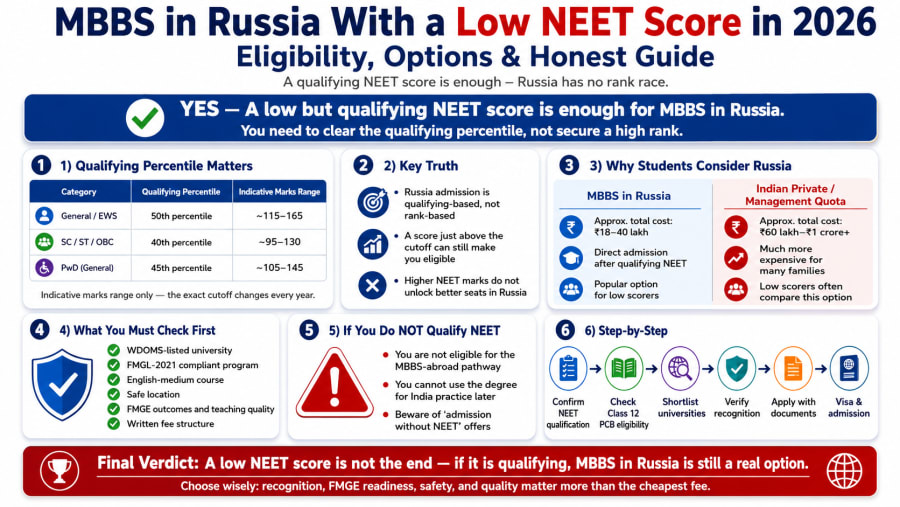
Short answer: No. You do not need a high rank or a high mark to secure admission to a recognised medical university in Russia. What you need is a NEET score that qualifies — meaning you cleared the minimum percentile set by the NMC/NBE for that year.
Here's the key distinction. Indian government MBBS seats are allocated by rank — lakhs of students compete for a limited number of seats, so a "good" score is whatever beats the cut-off. MBBS abroad eligibility, by contrast, is qualifying-based: once you're above the qualifying line, Russia doesn't care whether you scored just past it or well above it. There is no rank fight for the seat itself.
So the real question isn't "is my score high enough to win a seat?" — it's "did I clear the NEET qualifying percentile, and did I pick a university that will actually help me pass FMGE later?" That second half is where most students go wrong, and we'll come back to it.
Qualifying percentile, not rank — the concept that changes everything
Under the NMC's rules for students studying medicine abroad, any Indian student who wants to eventually practise in India must qualify NEET before taking admission abroad (a qualified NEET result is itself treated as your eligibility certificate to study abroad). The bar is a percentile, not an absolute mark, which is why the equivalent mark shifts every year with the difficulty of the paper.
| Category | Qualifying percentile | Typical qualifying marks (indicative range) |
|---|---|---|
| General / EWS | 50th percentile | ~115–165 (varies by year) |
| SC / ST / OBC | 40th percentile | ~95–130 (varies by year) |
| PwD (General) | 45th percentile | ~105–145 (varies by year) |
Note: The percentiles above are the long-standing NEET qualifying benchmarks set out in the Graduate Medical Education Regulations, but the exact qualifying mark changes every NEET session and the percentile itself can be revised by the NMC/NBE. Treat the marks column as an indicative range only (marks have dipped into the low 90s–110s for reserved categories in easier years) — always confirm the current-year qualifying cut-off from the official NTA NEET portal before making any decision.
The practical takeaway: if you cleared the qualifying percentile for your category — even by a single mark — you are eligible to take admission in Russia and, later, to sit the licensing exam in India. A score just past the qualifying line opens the same door abroad as a top score — there is no rank advantage for the seat.
Why low scorers pick Russia over India's management quota
A low NEET score in India usually leaves one domestic option for MBBS: a private or deemed university management-quota seat. That path is legal and legitimate — but the price tag is what pushes most middle-class families to look abroad.
| Factor | MBBS in Russia | Indian private / management quota |
|---|---|---|
| Total tuition (whole course) | ₹18–40 lakh (approx.) | ₹60 lakh – ₹1 crore+ |
| Score needed for the seat | Qualifying NEET only | Qualifying NEET (higher fee for lower rank) |
| Donation / capitation | None | Often expected on top of fees |
| Degree recognition | WDOMS-listed universities; FMGE/NExT to practise in India | MBBS recognised directly in India |
The gap is stark: a full MBBS in Russia often costs less than the first two years of an Indian private seat. For a family that would otherwise sell property or take a crushing loan, that difference is the whole reason Russia exists on the shortlist. The trade-off is that a Russian degree requires you to clear India's screening exam before practising here — an Indian private-college degree does not.
Costs vary widely by city and university, and exchange rates move constantly, so use these figures as a planning range rather than a quote. For current, itemised numbers see our detailed breakdowns on the MBBS in Russia page.
What a low scorer must check FIRST
When your score is low, the temptation is to grab the cheapest seat the fastest agent offers. That is exactly how students end up at a university that damages their career. Before anything else, verify these four things:
- ›WDOMS listing: The university must appear in the World Directory of Medical Schools — search it yourself, it is free. This is the baseline the NMC uses: no listing, no eligibility.
- ›FMGL-2021 compliance: The full ~54-month course and 12-month internship must be completed at the same institution in one country, in a recognised (English) medium, and the degree must let you practise in Russia on par with local citizens.
- ›FMGE / licensing track record: Don't just ask the agent — NBEMS publishes institute-wise FMGE performance reports showing how each foreign college's graduates actually did. Outcomes matter far more than a glossy brochure.
- ›Medium of instruction: Confirm MBBS is taught in English if you're not studying in Russian, and that clinical rotations aren't purely translation-dependent.
Note: Beware the phrase "NMC-approved university." The NMC does not pre-approve or recognise individual foreign universities. What actually counts is WDOMS listing plus FMGL-2021 compliance and, ultimately, your own FMGE/NExT result. Any agent selling you an "NMC-approved" tag is using marketing language — verify the real criteria yourself.
You can cross-check names against our regularly updated list of recognised universities in Russia for 2026 and the current NMC rules for MBBS abroad before you commit.
Realistic expectations — FMGE is still ahead
Here's the honest part most agents skip. A low NEET score gets you in — it does not get you a medical licence. To practise in India after an MBBS in Russia, you must clear the FMGE (Foreign Medical Graduate Examination), India's screening test. As of 2026 the NExT (National Exit Test) has been formally deferred by the NMC and pushed back repeatedly since — NMC signalled a further 3–4 year delay in October 2025 — so current abroad students still sit FMGE. Confirm the latest NMC notification, as this can change.
This is why choosing a university on outcomes, not just the lowest fee, matters so much for a low scorer. The cheapest seat with weak teaching and poor clinical exposure can leave you unable to clear FMGE — turning a "cheap" degree into the most expensive mistake of your life.
- !Don't chase the rock-bottom price: The absolute cheapest university often has the weakest FMGE outcomes. Save on tuition, not on the quality of your medical education.
- !Ignore "100% FMGE pass" guarantees: No one can guarantee your result. Ask for verifiable data, not marketing promises.
- !Don't skip the safety and location check: Prefer universities away from border/conflict regions and follow current MEA and Indian-embassy advisories before travelling.
- !Beware "admission without NEET" offers: If you plan to practise in India, a qualifying NEET is mandatory. Any offer bypassing it is a red flag.
Step-by-step for a low-NEET student in 2026
First: confirm eligibility
- Check you cleared this year's NEET qualifying percentile
- Confirm 50% in PCB in Class 12 (40% reserved)
- Verify you are 17+ by 31 December of admission year
Then: shortlist smartly
- Filter to WDOMS-listed, FMGL-2021-compliant universities
- Compare FMGE outcomes, fees and location safety
- Get the offer and fee structure in writing
In practice the sequence is: (1) confirm your NEET is qualifying, (2) build a shortlist of recognised universities that match your budget, (3) verify each on WDOMS and FMGL-2021, (4) compare on outcomes and safety — not price alone, (5) collect documents (Class 10/12 marksheets, NEET scorecard, passport), and (6) apply, arrange the invitation letter, and process your student visa. If you're unsure whether your score qualifies, our team can help you sanity-check it against the current cut-off and build a verified shortlist — start on the contact page.
Final Verdict — a low NEET score is not the end
If you cleared the NEET qualifying percentile for your category, you are genuinely eligible for MBBS in Russia — there is no rank race for the seat, and a modest score opens the same door as a high one. For a family staring at a ₹60 lakh–₹1 crore Indian private-college bill, Russia's ₹18–40 lakh range is a life-changing difference.
But a low score getting you in is only half the story. Your licence depends on clearing FMGE (NExT is deferred as of 2026 — verify the latest NMC notification), so choose a WDOMS-listed, FMGL-2021-compliant university on the strength of its outcomes, not just its lowest fee. Verify everything against official sources, ignore "NMC-approved" and "guaranteed pass" marketing, and you can turn a disappointing scorecard into a real medical career.
Share this article