Table of Contents
- What Are the NMC Rules for MBBS Abroad in 2026?
- NMC Eligibility Criteria for MBBS Abroad 2026
- 54-Month Duration Rule — The Most Misunderstood NMC Norm
- Mandatory Internship Rules — Abroad + India (CRMI)
- Medium of Instruction & Clinical Training Mandate
- FMGE vs NEXT — 2026 Comparison & Latest Status
- 2026 NMC Compliance Checklist Before Admission
- Where Indian Students Actually Go — Cost and FMGE Record by Country
- Common Mistakes Students Make — and How to Avoid Them
- What If Your Degree Doesn't Comply with NMC?
- How to Verify NMC Compliance Before Paying Any Fee
The university you choose for your MBBS abroad will either open every door in Indian medicine --- or close all of them. The single factor that decides which way it goes isNational Medical Commission (NMC) compliance. A degree from a non-compliant university, however prestigious it sounds locally, is unusable in India: no FMGE, no registration, no practice, no PG.
This 2026 guide breaks down every NMC rule for MBBS abroad — the 54-month duration norm, internship mandates, English-medium requirement, FMGE vs NEXT status, country-level compliance, and the document checklist you'll need at every stage. By the end, you'll know exactly what to verify before signing any admission letter.This guide is tailored for MBBS abroad 2026 applicants tracking NMC rules 2026 and FMGE 2026 updates.
What Are the NMC Rules for MBBS Abroad in 2026?
The NMC rules for MBBS abroad are legally binding standards set by India's National Medical Commission under the Foreign Medical Graduate Licentiate Regulations, 2021. These rules decide whether a foreign medical degree is recognised in India — and therefore, whether the graduate can sit for FMGE/NEXT, register with a State Medical Council, and practice medicine.
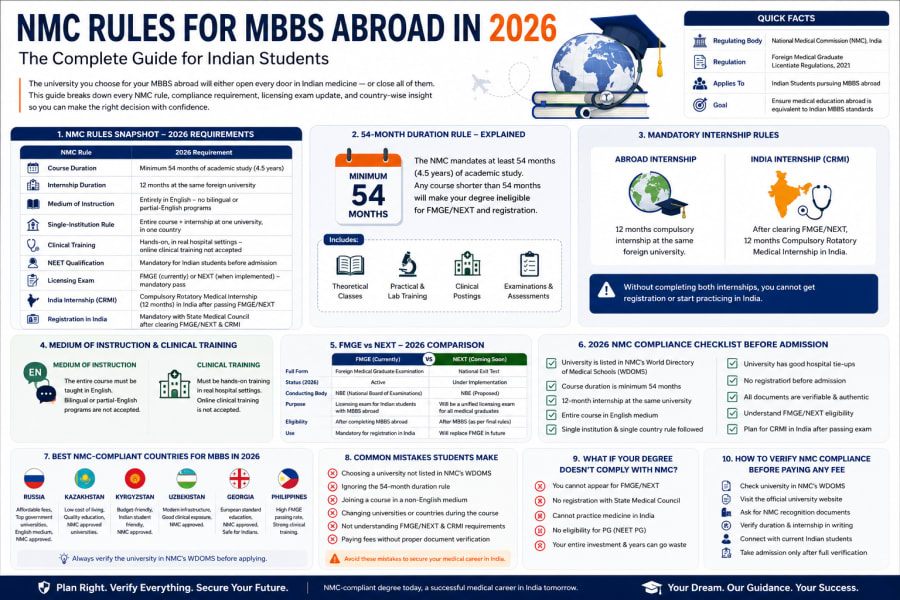
The intent is simple: every Indian-origin doctor trained abroad must match the academic depth and clinical exposure of an MBBS graduate from an Indian medical college. Here's the full snapshot of what the rules cover in 2026:
| NMC Rule | 2026 Requirement |
|---|---|
| Course Duration | Minimum 54 months of academic study (4.5 years) |
| Internship Duration | 12 months at the same foreign university |
| Medium of Instruction | Entirely in English — no bilingual or partial-English programs |
| Single-Institution Rule | Entire course + internship at one university, in one country |
| Clinical Training | Hands-on, in real hospital settings — online clinical training not accepted |
| NEET Qualification | Mandatory for Indian students before admission |
| Licensing Exam | FMGE (currently) or NEXT (when implemented) — mandatory pass |
| India Internship (CRMI) | 12-month Compulsory Rotating Medical Internship after FMGE/NEXT |
| Applicability | All Indian students admitted abroad on or after 18 November 2021 |
Key principle: Failing even one of these conditions invalidates the entire degree for Indian practice. There is no partial recognition, no exception process, and no appeal mechanism for non-compliance discovered after admission. Verification has to happen before you pay tuition.
NMC Eligibility Criteria for MBBS Abroad 2026
Before you even shortlist universities, confirm you meet NMC's basic eligibility for foreign medical graduate registration. Without these in place, even a fully compliant course won't help you:
- ›NEET UG qualification: Mandatory. You must clear NEET in the year of admission abroad. Note: you don't need to clear the MBBS cut-off — qualifying the percentile is enough. But your NEET scorecard must be valid for the admission year.
- ›Age: Minimum 17 years on or before 31st December of the admission year.
- ›Class 12 academics: Physics, Chemistry, Biology, and English as core subjects, with at least 50% aggregate in PCB (40% for SC/ST/OBC reserved candidates).
- ›Indian passport: Valid for at least 18 months at the time of visa application.
- ›Medical fitness: A standard medical fitness certificate from an authorised medical practitioner — required for both visa and university admission.
- ›No FMGE-blocking history: Students previously caught for academic dishonesty in NEET or those with cancelled foreign admissions may face additional scrutiny during FMGE eligibility verification.
54-Month Duration Rule — The Most Misunderstood NMC Norm
This is the single rule that catches most unsuspecting students. The NMC requires the academic portion of an MBBS abroad to run for at least 54 months — that's 4.5 calendar years of academic study, separate from the 12-month internship. Together: 66 months, or 5.5 years minimum.
| Course Structure | NMC Compliance |
|---|---|
| 5-year academic + 1-year internship at same university | ✓ Compliant |
| 4.5-year academic + 1-year internship at same university | ✓ Compliant (minimum) |
| 4-year accelerated MBBS / MD program | ✗ Not Compliant |
| Academic + internship split across two universities | ✗ Not Compliant |
| Course completed in less than 54 months due to credit transfer | ✗ Not Compliant |
Watch out for: Some agents push 4-year "fast-track" or "American-style" MD programs in countries like Belarus, Ukraine, or parts of Eastern Europe. These can be excellent degrees globally, but they are not recognised by NMC. If a counselor mentions "you'll save a year" — that's the red flag.
Mandatory Internship Rules — Abroad + India (CRMI)
The internship rules trip up many students because there are two separate internships involved — one abroad, one in India. Both are mandatory.
Foreign Internship (12 months)
- ›Must be a full 12 months — no exceptions for shorter formats
- ›Must be at the same university where the academic course was completed
- ›Must be hospital-based clinical rotations, not classroom or research
- ›Cannot be done in India, even at a partner institution
India Internship — CRMI (12 months)
- ›Compulsory Rotating Medical Internship at an NMC-recognised Indian hospital
- ›Begins only after clearing FMGE/NEXT
- ›A stipend is paid, but the amount is set state by state and revised periodically — check the rate published by the State Medical Council you will register with
- ›Mandatory for all students admitted abroad on or after 18 November 2021
Medium of Instruction & Clinical Training Mandate
The full course — every lecture, every clinical rotation, every assessment — must be conducted in English. Universities offering bilingual programs (e.g., partial-English with local-language clinical rotations) do not meet NMC compliance, even if the diploma claims "English medium".
Equally important: the NMC has explicitly clarified that clinical training must be hands-on in real hospital settings. Online learning, virtual hospitals, and simulation-only training do not count as clinical exposure. This rule was tightened post-COVID, and any clinical training conducted online during a student's program must be compensated with equivalent on-site practical training before the degree is recognised.
2026 update: NMC has begun cross-verifying clinical training records during FMGE eligibility checks. Students from universities that ran extended online clinical programs during 2020–2022 should explicitly confirm with their university how that training was compensated, and obtain documentation before applying for FMGE.
FMGE vs NEXT — 2026 Comparison & Latest Status
There has been continuous noise about NEXT replacing FMGE since 2022. As of August 2026 FMGE is still the active licensing exam for foreign medical graduates. NMC has deferred NEXT by a further three to four years and has spoken about running mock exams first, so treat any specific start year you read as a guess rather than a notified date. Here is how the two compare:
| Parameter | FMGE (Current) | NEXT (Future) |
|---|---|---|
| Conducting Body | NBEMS | NMC (via NBEMS) |
| Frequency | Twice a year (June, December) | Likely twice a year |
| Format | Single MCQ paper, 300 questions | Two-step: NEXT-1 (theory) + NEXT-2 (clinical) |
| Pass Criterion | 50% aggregate | To be notified |
| Applies To | Foreign medical graduates only | Both Indian + foreign graduates (unified exam) |
| Replaces | N/A | FMGE + NEET-PG (combined exam) |
| Difficulty Level | Moderate | Not established — the format is still being designed |
| Status in 2026 | Active — June and December sessions confirmed | Deferred by NMC for a further 3–4 years; no start date notified |
FMGE 2026 status: the June 2026 session was held on 28 June 2026 and its results were published on 7 July 2026. The December 2026 session follows the usual NBEMS calendar. Always verify dates directly on natboard.edu.in before planning your post-MBBS timeline, because this page will go stale between sessions.
2026 NMC Compliance Checklist Before Admission
Before you pay any application fee, sign any agreement, or book any travel — run this 10-point compliance audit on your shortlisted university:
- 1.WDOMS listing: Search the university at search.wdoms.org. If it's not listed, FMGE eligibility will be rejected outright.
- 2.Course duration confirmation: Get a written confirmation from the university that the course is 54+ months academic + 12 months internship.
- 3.English medium proof: Ask for the official medium-of-instruction certificate template the university issues to graduates. This is required at FMGE registration.
- 4.Single-institution confirmation: Confirm that internship will be at the same university — not a partner hospital in a different country or city under a different administration.
- 5.FMGE pass rate: Check the university's FMGE pass rate for the last 3 years. NBE publishes these stats. Below 20% pass rate = serious red flag.
- 6.Clinical hospital verification: Confirm the university has its own teaching hospital(s) with adequate patient flow — not just classroom-based education.
- 7.Recognition by India embassy: Verify that the Indian Embassy in that country has not issued any travel/admission advisory against the university.
- 8.NEET scorecard validity: Ensure your NEET scorecard for the admission year is valid and qualifying.
- 9.Country-level disruption risk: war and other disruption can interrupt clinical training, which is the part of the degree NMC scrutinises. NMC has issued case-specific schemes for affected students rather than a blanket rule, so never assume either a rejection or a relaxation — check the current notification for that country.
- 10.Written compliance commitment: Get a written, dated letter from the university confirming the program meets NMC 2021 regulations. Keep it as documentary proof.
Where Indian Students Actually Go — Cost and FMGE Record by Country
NMC does not maintain a country-wise approved list. It sets criteria, and a degree either meets them or does not, so no country is "NMC approved" and no country is "NMC compliant" either. What can be compared is cost and the published FMGE record. The figures below are the six-year cost brackets from our own country pages and the institute-wise NBEMS 2024 report:
| Country | Total Cost (6 yrs) | FMGE 2024 (passed of appeared) | What to check |
|---|---|---|---|
| Russia | ₹21 – ₹53 Lakhs | 3,331 of 11,276 (29.54%) | Large Indian community; per-university records vary enormously |
| Georgia | ₹30 – ₹50 Lakhs | 1,505 of 4,221 (35.66%) | English-medium throughout; check the degree is a single 6-year MD |
| Uzbekistan | ₹16 – ₹22 Lakhs | 197 of 490 (40.20%) | Highest 2024 rate, but on a small cohort; verify clinical infrastructure |
| Kazakhstan | ₹20 – ₹35 Lakhs | 1,261 of 5,018 (25.13%) | Sits close to the all-India average |
| Kyrgyzstan | ₹16 – ₹26 Lakhs | 3,792 of 15,135 (25.05%) | Cheapest bracket and the largest cohort of any country |
| Philippines | ₹20 – ₹32 Lakhs | 2,003 of 9,967 (20.10%) | BS+MD structure needs careful FMGL-2021 mapping |
| Bangladesh | ₹24 – ₹38 Lakhs | 914 of 2,822 (32.39%) | Curriculum closely aligned with the Indian MBBS |
| Nepal | ₹45 – ₹65 Lakhs | 545 of 1,809 (30.13%) | Above the national average; SAARC quota may reduce fees |
Critical: Country-level compliance is not the same as university-level compliance. A country can have 30 medical universities, of which only 10 meet NMC criteria. Always verify the specific university — never trust country-level reputation alone.
Common Mistakes Students Make — and How to Avoid Them
- ›Falling for "fast-track" programs: Any 4-year medical program is non-compliant. The savings of one year cost the entire degree's validity in India.
- ›Choosing based on agent commission: Agents are paid per student by universities. The cheapest "deal" often points to universities with the lowest FMGE pass rates. Verify pass rates independently.
- ›Skipping NEET because the university doesn't ask for it: The university doesn't enforce it — NMC does, at FMGE registration. Without a valid NEET scorecard, your degree is unusable in India.
- ›Trusting "tie-up" universities: Indian "partner colleges" of foreign universities have caused FMGE rejections because the academic credit ends up split across institutions, breaking the single-institution rule.
- ›Ignoring internship country: Some universities allow internship in India to attract students. This kills NMC compliance — internship must be in the country of academic study.
- ›Not documenting clinical training: Get clinical rotation logs signed and stamped during the program — not at graduation. NMC has been demanding clinical training documentation during FMGE eligibility checks.
What Happens If Your Degree Doesn't Comply with NMC?
Non-compliance has hard, irreversible consequences:
- ›FMGE / NEXT eligibility denial: NBEMS will reject your application — no exam attempt, no second chance.
- ›No State Medical Council registration: Without registration, you cannot legally write "Dr." before your name in India for clinical practice.
- ›No PG eligibility: NEET-PG / NEXT-2 require valid undergraduate registration. Without it, no MD/MS in India.
- ›Cannot practice in India: Practising medicine without registration is a punishable offence under the NMC Act, 2019.
- ›Limited international fallback: Some students attempt USMLE / PLAB / AMC, but these have their own eligibility checks — and a non-compliant degree often fails ECFMG or GMC verification too.
How to Verify NMC Compliance Before Paying Any Fee
Run this verification flow on every shortlisted university — including ones recommended by agents you trust:
- ›Step 1 — WDOMS check: Search the university on search.wdoms.org. Confirm the listing is active and matches the legal name on the admission letter.
- ›Step 2 — FMGE pass rate audit: Pull the last 3 years of FMGE pass rate data for the university from natboard.edu.in. Use this as a real-world quality signal.
- ›Step 3 — NMC website check: Visit nmc.org.in and search the Foreign Medical Graduates section for any university-specific advisories or notifications.
- ›Step 4 — Indian Embassy advisory: Check the website of the Indian Embassy in that country for student advisories.
- ›Step 5 — Talk to current students: Speak directly with at least 2–3 Indian students currently enrolled at the university (not alumni picked by the agent). Ask about clinical exposure, language barriers, and FMGE preparation support.
- ›Step 6 — Get NMC compliance in writing: Before paying any fee, request a written, dated, signed compliance letter from the university citing NMC 2021 regulations.
The 2026 Bottom Line
NMC compliance is not a checklist for after admission — it's the deciding factor before admission. Every rule (54-month duration, single-institution course, English medium, hands-on clinical training, foreign internship, FMGE/NEXT, India CRMI) exists for one reason: to ensure your foreign MBBS holds up against any Indian-trained graduate.
Skipping verification — even by one rule — invalidates the entire 5.5–6 years of effort and ₹21 lakhs to over ₹1 crore of investment. There is no appeal, no exception, and no shortcut.
For complete admission guidance through universities we have checked against the FMGL-2021 criteria — contact A.J Trust at Chennai (044-26614485), Madurai (0452-2621088), or Delhi (011-45706691). We pre-verify every university we recommend against the full NMC 2021 checklist before you pay a single rupee.
Share this article