


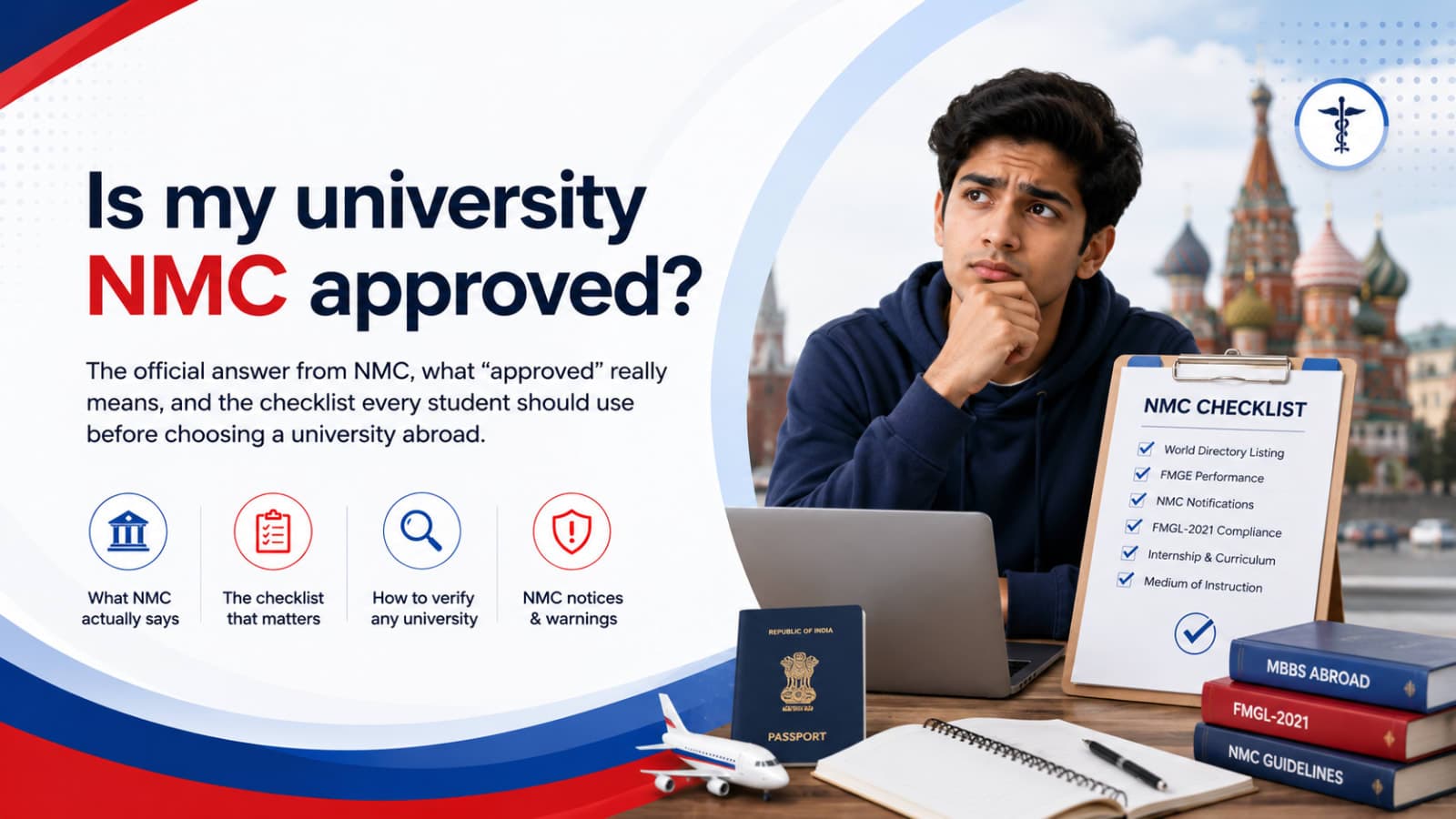
Is my university NMC approved?
Last checked against NMC and NBEMS sources on 4 October 2026.
Short answer
No university anywhere is NMC approved, because NMC approves no foreign universities. It keeps no list of them. Its own study-abroad page says it “does not endorse any list of Foreign Medical Institutions/ Universities for MBBS or equivalent course”.
What NMC regulates is your degree, through the Foreign Medical Graduate Licentiate Regulations, 2021. Your degree can be NMC-compliant under FMGL-2021. Your university cannot be NMC approved.
Three things about any university are checkable, and you can do all three in about twenty minutes: its World Directory listing, its FMGE record in the NBEMS reports, and whether NMC has ever issued an alert naming it.
If you have spent a week reading MBBS-abroad websites, you have seen the phrase on every one of them. Green tick, “NMC Approved”, sometimes “WHO Approved” underneath. We had it on this site too, on 127 university entries, until we went looking for the list it was supposed to come from and could not find one.
This page is what we found. It is long because the honest answer has a few parts, and because the short version — “that is not a real thing” — is useless to somebody who has to choose a university next month.
Why every website says it
Because it used to be true. The Medical Council of India did publish a list of foreign medical institutions, put together from information supplied by Indian embassies and high commissions. Agents quoted it, students asked for it, and “MCI approved” meant something you could check.
MCI was wound up in 2020 and NMC took over. NMC did not carry the list forward. It went further and said, in one line on its study-abroad page, that it endorses no such list. The phrase in the industry simply changed from “MCI approved” to “NMC approved” and nobody checked whether the thing behind it still existed.
The old data has not entirely gone, which is part of why the belief survives. An MCI-era API endpoint still answers on NMC’s own domain and returns 496 institutions across 73 countries, 72 of them in Russia and 23 in Georgia. No page on NMC’s site links to it. The front-end that used to display it redirects to a login screen. And it is stale in a way that matters: it still lists the Belize colleges that NMC told students to avoid in July 2025. If somebody shows you a list, this is probably where it came from.
What NMC actually says
Here is the paragraph, from NMC’s page for students going abroad, quoted in full because it is short and it settles the question:
“It may be noted that the erstwhile Medical Council of India had provided a list of foreign Medical Institutions/Universities for MBBS or equivalent course based upon the information received from the Indian Embassy/High Commission of India concerned. However… It is to clarify that the National Medical Commission does not endorse any list of Foreign Medical Institutions/ Universities for MBBS or equivalent course.”
That is the whole basis for everything else on this page. NMC names foreign universities in one situation only, which is when it wants to warn you about one. There are eight such notices since 2021 and they are listed below. There is no positive counterpart.
The checklist that replaced the list
FMGL-2021 has a Schedule-I, and its title is worth reading slowly: “Criteria to recognise foreign medical graduates applying for licence or permanent registration to practise in India”. Criteria, and graduates. Not a list, and not institutions. If somebody tells you to check the “NMC 2021 list” before you take admission, this is what they mean, and the advice is good.
Regulation 4 sets out what your degree has to satisfy:
- ›At least 54 months of study for the degree itself.
- ›A 12-month internship at the same foreign institution. Not a different one, and not split across countries.
- ›English as the medium of instruction.
- ›The subjects listed in Schedule-I.
- ›A qualification that lets you register and practise medicine in that country, on the same footing as its own citizens.
- ›After you come home, a further 12-month supervised internship in India, applied for through the Commission.
Then you sit FMGE. Two conditions catch people more than the rest. The first is the internship: a lot of six-year degrees, Russian ones especially, are a single continuous programme with no separate internship year in the sense NMC means, and postgraduate training is a different qualification entirely. The second is the licence condition, because it depends on the university keeping its own accreditation at home — and that can be taken away, as the Armenian case below shows.
Note
NEET is separate and it is not optional. Since May 2018 an Indian student going abroad for a primary medical qualification has to have qualified NEET, and the NEET result itself acts as the eligibility certificate. There is no route around it, whatever an agent tells you.
Two things that look like approval and are not
Once people accept there is no approved list, they usually reach for the nearest substitute. There are two popular ones and both fail the same test.
A World Directory listing
The World Directory of Medical Schools is a genuine, useful reference and you should check it. It is not approval. The directory says so on its own results page: listing “does not denote recognition, accreditation, or endorsement”. It confirms the school exists and is operating.
Test it against a real case. All three Uzbek universities NMC issued an alert about in April 2026 are in the directory. Bukhara State Medical Institute is F0000095, Samarkand is F0001564, Tashkent State Medical University is F0002249. Listed, and alerted, at the same time.
Students who sat FMGE
This one sounds airtight. If NMC lets a university’s graduates sit the exam, surely NMC accepts the university. It does not work that way. NBEMS does not screen institutions in advance; eligibility is assessed for each candidate at registration, against the FMGL criteria.
Bukhara again makes the point. In the NBEMS 2024 report it had 299 candidates and 143 of them passed, a rate of 47.83% that beats most Russian universities outright. NMC alerted that same institute in April 2026. A good pass rate and an NMC alert can sit on the same university, and neither one is a verdict on the other.
The newest version of the pattern is a university with no FMGE record at all being sold as “NMC approved”: Kalmyk State University's first MBBS batch only left India in 2025, so no pass rate can exist before about 2031, and the approval claim is the only “credential” its marketing has. We took that one apart claim by claim in the Kalmyk verified-facts check.
While we are here: “WHO approved”
This one has a clean answer. The World Health Organization has never accredited medical schools, and it said so in plain words back when it still ran a directory of them: WHO “has no authority to grant any form of recognition or accreditation to schools of medicine or other training institutions. Such a procedure remains the exclusive prerogative of the national government concerned.”
That directory stopped being updated and its successor is the World Directory of Medical Schools, published by the World Federation for Medical Education and FAIMER. Neither is WHO. When a website says a university is WHO approved, it means the school is in that directory, which brings you back to the paragraph above.
How to check any university yourself
Three checks. None of them needs an agent, and together they take about twenty minutes.
Find it in the World Directory
Search the name at search.wdoms.org. You want it listed, currently operational, and you want its FAIMER ID. If a university you are being sold is not there at all, stop and ask why. Note the sponsor notes too — the ECFMG note tells you whether graduates can go on to US certification.
Look up its real FMGE record
NBEMS publishes performance institution by institution at natboard.edu.in, and every year from 2012 is public. Read it as passed-of-appeared, never as a bare percentage: 4 of 4 is 100% and tells you nothing. We have the same data sorted by university on our FMGE pass rates page.
Check whether NMC has named it
Search the university’s name against the notices in the table below, and check NMC’s notices page for anything newer. NMC also tells students to ask the Indian Embassy in that country directly, which is worth doing for any university you are serious about.
Every NMC notice that names a foreign university
These are the notices we could find on nmc.org.in going back to 2021, read from the source PDFs. Two things to keep in mind. An alert is not a ban — NMC advises caution and warns that the criteria may not be met, and it does not de-recognise anything. And this list has no positive counterpart, so a university being absent from it means only that NMC has not warned about it.
Alert — advises “extreme caution”, after the Indian Embassy in Tashkent flagged over-capacity admissions and teaching not in English
- Bukhara State Medical Institute
- Samarkand State Medical University
- Tashkent State Medical University
- TIT Institute of Medical Sciences, Bangalore (offshore campus of TSMU Termez branch, in India)
- TSMU Termez Branch
- Bukhara State University
Alert — the strongest wording NMC has used: students “strictly advised to avoid seeking admission”
- Central American Health and Sciences University, Belize
- Columbus Central University, Belize
- Washington University of Health and Sciences, Belize
- Chirchik Branch of Tashkent State Medical University, Uzbekistan
Public notice — Armenia’s own Ministry of Education, by order 291-A/2 of 18 Feb 2022, terminated this university’s licence for its Bachelor’s and Master’s programmes
- St. Tereza Medical University, Yerevan
Public notice — complaints from Indian students already enrolled: degrees withheld on completion, extortion, agents issuing fake admission letters, accreditation not renewed
- St. Tereza Medical University, Yerevan
Public notice — a forged NMC letter was circulating in this university’s name. A warning about the forgery, not about the university’s teaching
- Avicenna International Medical University, Bishkek
Advisory — the Ministry of External Affairs told NMC these colleges had opened within the previous year; students advised to check them carefully
- Avicenna University
- Adam University
- Royal Metro
- Int'l Medical University
- Salymbekov University
- ABC (the notice adds “etc.”)
Public notice — a bar, and the only country-wide one. No individual college is named
- Any medical college in Pakistan
Health Ministry letter asking NMC to republicise the erstwhile MCI Board of Governors’ public notice of August 2020: a qualification from any medical college in Pakistan-occupied Jammu & Kashmir and Ladakh does not entitle a person to registration in India
- Any medical institution in PoJKL
Note
NMC adds notices without warning and we check this page against its notices index periodically, not daily. Before you act on anything here, open NMC’s own notices page and look for anything newer than 4 October 2026.
What to ask before you pay
Send these to the university, in writing, and keep the reply. Any agent worth using will get them answered for you rather than telling you not to worry.
- ›How many months is the degree, and does the 12-month internship happen at your institution?
- ›Which years are taught in English, and what language are ward rounds and patient histories in?
- ›Does the degree let a graduate register and practise medicine in your country, on the same terms as your own citizens?
- ›Is the university's licence or accreditation current, and when was it last renewed?
- ›What is your FAIMER ID in the World Directory?
The last question is a quick honesty test. It takes any real university thirty seconds to answer, and you can check the answer yourself in the directory.
Sources
NMC quotations are from its information page for students going abroad and from the notices linked above. FMGL-2021 text is from the gazette notification of 18 November 2021. Pass rates are read from the NBEMS institute-wise performance reports. Directory listings and FAIMER IDs are from search.wdoms.org. Checked 4 October 2026.
Regulations change and notices are added. Check the primary sources before you act, and ask us if something here does not match what you have been told.