Updated: 26 August 2026. The NBEMS-appointed committee has reported. It refused grace marks, but recommended structural changes to the exam itself: three sittings a year, a capped difficulty mix, a way for candidates to see their own responses against the correct answers, and a review of the fee. Candidates were still protesting in Delhi's Gautam Nagar on 21 August, after the recommendations were known. The Supreme Court notice remains live. Full detail in what the committee actually decided.
Table of Contents
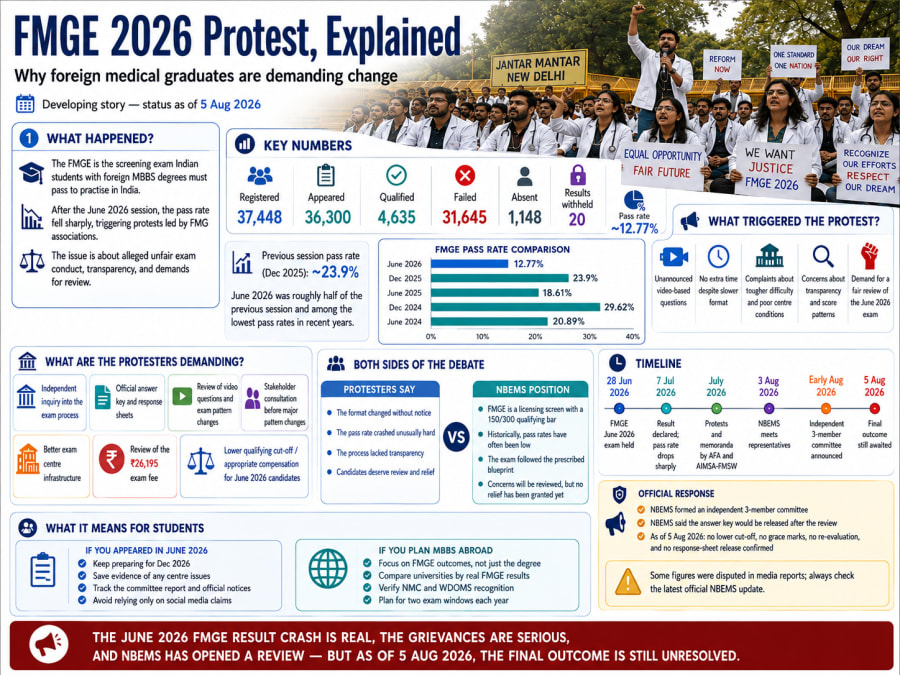
On 7 July 2026, the National Board of Examinations in Medical Sciences (NBEMS) declared the result of the Foreign Medical Graduate Examination (FMGE) June 2026 session. Counted from the declared result, only 4,635 of the 36,300 candidates who appeared cleared it — a pass rate of about 12.77%, the lowest FMGE result since June 2023 (NewsX, 7 July 2026). Minister of State for Health and Family Welfare Anupriya Patel subsequently put the figure at 12.78% in a reply in Parliament (Medical Dialogues, 2 August 2026).
What followed was one of the most closely watched stories in the MBBS-abroad community in 2026: two protests by foreign medical graduates (FMGs), a Supreme Court notice to the Health Ministry and NBEMS, and an NBEMS-appointed committee now reviewing how the exam was conducted.
This explainer sets out what happened, what the associations allege, what is actually attributable to NBEMS, and what remains unresolved as of 5 August 2026. We have kept the register strict throughout — allegations are labelled as allegations — because careers are at stake and a committee exists precisely to test these claims.
One clarification up front: this FMGE agitation is separate from the 2026 Delhi Jantar Mantar protests over the NEET-UG paper leak and CBSE marking, which ran from 6 June to 25 July 2026 and were led by different groups. They share a venue, but they are different movements with different participants and demands.
What is the FMGE protest?
The FMGE is the mandatory licensing screening test that Indian citizens and OCIs holding a foreign primary medical qualification must clear before they can register to practise in India. Until 2026 it was held twice a year, in June and December, though the December session was in practice held the following January (the December 2025 session ran on 17 January 2026). On 28 August 2026 NBEMS announced that FMGE will now be held three times a year; our FMGE exam guide has the current dates.
Per the official NBEMS information bulletin, the exam is one paper of 300 MCQs delivered in two parts on a single day — 150 questions in each part, with 150 minutes a part in June 2026 (the October 2026 bulletin allows 153) — with no negative marking and a pass mark of 150 out of 300. Each part is further divided into time-bound sections that lock: once a section's allotted time is over, candidates cannot return to it or change those answers.
The "protest" refers to an agitation by foreign medical graduates after the June 2026 result, led by the All FMGs Association (AFA) and the Foreign Medical Students' Wing of the All India Medical Students' Association (AIMSA-FMSW). It combined two street demonstrations with memoranda to the Health Ministry and an online campaign. Their central claim is that the June 2026 exam was conducted unfairly — chiefly because of a format change introduced without notice — and that the result should therefore be reviewed and the process made transparent.
NBEMS is reported to have agreed to examine the concerns through an independent committee, but it has not conceded the core demands — and it has said publicly that lowering the passing marks is beyond its authority and can only be done by the Supreme Court.
What triggered it: the June 2026 result
The FMGE June 2026 was held on 28 June 2026, the result was declared on 7 July 2026, and scorecards were released on 16 July 2026. Here is the full breakdown as counted from the declared result.
| FMGE June 2026 | Figure |
|---|---|
| Registered candidates | 37,448 |
| Absent | 1,148 |
| Appeared | 36,300 |
| Qualified | 4,635 |
| Failed | 31,645 |
| Results withheld | 20 |
| Pass rate (of those who appeared) | ~12.77% |
Note on the numbers: you will also see this result reported as 12.4% (Medical Dialogues) or 12.3% (Newslaundry). Those are the same result over a different denominator — 4,635 against all 37,448 registered gives 12.4%, while 4,635 against the 36,300 who actually appeared gives 12.77%. We use the appeared base, because a rate that includes 1,148 people who never sat the exam understates how the candidates who did sit it performed. NBEMS does not publish a pass percentage of its own — its official output is a digitally signed PDF of roll numbers, scores and qualifying status — which is why reported figures differ.
The parliamentary reply added a detail that reframes the story: roughly 88% of the candidates were repeaters, and first-time takers passed at about 35%. In other words, the headline rate is heavily weighted by candidates attempting the exam again — a structural feature of the FMGE that rarely makes the headlines.
Why the result stung is the comparison. The immediately prior session (December 2025, held January 2026) had a pass rate of about 23.9%, so June 2026 was roughly half of that. The FMGE has been chronically hard for years, but June 2026's ~12.77% is the lowest result since June 2023. Only two recent sessions have been lower: June 2023 (10.20%) and June 2022 (10.61%).
| FMGE session | Pass rate (as reported) |
|---|---|
| June 2026 | ~12.77% (lowest since June 2023) |
| December 2025 | ~23.9% |
| June 2025 | 18.61% |
| December 2024 | 29.62% |
| June 2024 | 20.89% |
| December 2023 | ~21% (reports vary: 20.57-22.03%) |
| June 2023 | 10.20% |
| December 2022 | 32.21% |
| June 2022 | 10.61% |
Historical pass rates are compiled from published reporting of each session's declared result (see Careers360's session-wise FMGE pass-percentage record), not from an official NBEMS statistics release, and figures for some sessions differ between outlets. FMGE pass rates also move substantially from session to session. Treat this table as an indication of the trend rather than a fixed benchmark, and check the latest declared result for current figures.
Alongside the raw pass rate, the protesting associations allege a set of specific irregularities. These are allegations and demands, not confirmed findings — the committee exists to test them:
- !Video-based clinical questions (short 20-40 second clips) were introduced without prior notice or a mock demonstration. Newslaundry reports "more than 20" from candidate accounts, while the Supreme Court petition puts the count at 12. The official information bulletin makes no mention of video questions anywhere in its scheme of examination, which supports the no-prior-notice complaint.
- !The exam duration was left unchanged despite the more time-consuming video format.
- !A sharp, uncommunicated jump in difficulty — the associations say it was tougher than NEET PG and INI-CET.
- !Poor test-centre conditions at some venues, including allegations of a centre without working air conditioning in peak summer.
- !Near-identical scores across consecutive attempts for some candidates, which they say raises evaluation and integrity concerns.
Timeline: two protests and a court notice
- 128 June 2026 — NBEMS conducts FMGE June 2026 (one paper, 300 MCQs, delivered in two parts). Candidates later report unannounced video-based clinical questions.
- 27 July 2026 — Result declared. 4,635 of 36,300 who appeared qualify — about 12.77%, roughly half the previous session.
- 310 July 2026 — First protest: AFA and AIMSA-FMSW demonstrate outside the NBEMS office in New Delhi. NBEMS says reducing the passing marks is beyond its authority and can only be done by the Supreme Court (Medical Dialogues).
- 416 July 2026 — Scorecards released to candidates.
- 524 July 2026 — The Supreme Court issues notice to the Union Health Ministry, the NMC and NBEMS on a plea by 12 FMGE June 2026 candidates seeking release of the question papers, response sheets and official answer keys (Medical Dialogues, reported 25 July 2026).
- 63 August 2026 — Second protest, at Jantar Mantar. A representation is submitted to Union Health Minister J.P. Nadda, and NBEMS invites association representatives to a meeting the same afternoon (Medical Dialogues).
- 74 August 2026 — Per the representatives who attended, NBEMS says it has constituted a three-member committee to review the concerns and submit findings within about three weeks, with the answer key to follow that review (Medical Dialogues).
Note: A "3 July 2026" protest date circulates in some AI-generated search summaries. It is wrong on two counts — it predates the 7 July result, and the underlying reporting dates the two protests to 10 July (outside the NBEMS office) and 3 August (Jantar Mantar).
What the protesters are demanding
According to Medical Dialogues, the associations put forward seven core demands, led by two: a lower cut-off for June 2026 candidates, and release of the answer key.
- ›An independent inquiry into how the June 2026 exam was conducted.
- ›Publication of the official answer key and candidates' response sheets — normally withheld by NBEMS under its non-disclosure policy.
- ›A review of the newly introduced video-based questions, and of the collection of previous FMGE roll numbers.
- ›Infrastructure improvements at exam centres.
- ›A review of the examination fee, which the associations argue is high relative to other national medical exams. (The official NBEMS information bulletin puts the FMGE June 2026 fee at Rs 6,195 — Rs 5,250 plus 18% GST. The Rs 26,195 figure quoted in some reporting does not match the bulletin.)
- ›A transparent stakeholder-consultation mechanism before any major pattern change.
- ›Most prominently, "appropriate compensation by lowering the qualifying cut-off" for June 2026 candidates.
Note: The examination fee is revised from session to session — always take it from the information bulletin for the session you are applying to, not from reporting. The Rs 6,195 figure above is what the June 2026 bulletin states; a higher figure circulating in coverage of the protest does not match that bulletin, and we have not been able to establish where it came from.
Both sides of the debate
The debate has two layers. One is about how this particular exam was run; the other is the older, structural question of what a licensing screen is for. Here is each side, fairly stated.
The exam-conduct case
- Pass rate roughly halved versus the prior session
- Video questions added without notice or a mock demo
- The bulletin never mentioned video questions
- No extra time despite a slower format
- Alleged difficulty spike and poor centre conditions
- Near-identical repeat scores raise evaluation doubts
The standards & screening case
- FMGE is a licensing screen; 150/300 has long been the bar
- Pass rates have been low (mostly 10-30%) for years
- About 88% of June 2026 candidates were repeaters; first-timers passed at ~35%
- A coaching-institute head told Newslaundry officials said the exam followed the prescribed blueprint; NBEMS has not said this on record
- NBEMS says lowering the cut-off is beyond its authority
The official response and where it stands
The most consequential development is judicial. On 24 July 2026 — more than a week before the Jantar Mantar protest — the Supreme Court issued notice to the Union Health Ministry, the NMC and NBEMS on a plea by 12 FMGE June 2026 candidates, seeking release of the question papers, response sheets and official answer keys, and a transparent mechanism for verification and re-evaluation (Medical Dialogues, reported 25 July 2026).
NBEMS has also engaged directly. It met association representatives on 3 August and, according to those who attended, told them it had constituted a three-member committee — described as independent of NBEMS — to examine the candidates' concerns and submit findings within about three weeks (Medical Dialogues, 4 August 2026). NBEMS has not published a notice on its own FMGE page confirming this, so that account rests on a single meeting readout.
NBEMS is also reported to have agreed to release the FMGE June 2026 answer key once that review is complete — a notable shift for this exam. Its own information bulletin for June 2026 stated that the board would not entertain any request to share examination content, including answer keys or answer sheets, and that there was no provision for re-totalling, re-evaluation or grace marks in the FMGE. The October 2026 bulletin changes the first part: NBEMS will publish the answer key, and candidates can see the correct answers and their own marked responses in their login. Newslaundry reports that NBEMS defended that non-disclosure policy before the Central Information Commission in 2024, arguing a limited question bank and that releasing material would encourage "rote memorisation rather than analytical thinking."
What has not happened matters just as much. As of 5 August 2026 there is no lowered cut-off, no grace marks, no re-evaluation and no response-sheet release. NBEMS's own stated position is that reducing the passing marks is beyond its authority and can only be done by the Supreme Court — which means a court-driven outcome is at least as plausible as a committee-driven one. The Health Ministry has not issued a separate public statement on the controversy.
Note: Read the three-week timeline precisely. It is a deadline for the committee to submit findings — not a commitment to any particular remedy. Statements circulating that "within three weeks every matter will be resolved" are an expectation, not something NBEMS has promised.
What the committee actually decided
In a letter to the All India Medical Students' Association on 20 August 2026, NBEMS said its three-member committee had completed what it called a comprehensive and objective review of the June session. The recommendations were reported on 22 August 2026 (Medical Dialogues, 22 August 2026). The short version: the candidates lost the argument about their own result, and won most of the argument about the exam.
On the demand that mattered most to the June cohort, compensatory marks, the committee said no. It recorded that it did not find sufficient evidence to conclude that the video-based questions or the difficulty level caused any material adverse impact, and that the legal framework does not provide for grace marks. For anyone who sat June 2026 and missed the cut-off, that is the answer: the result stands.
| What was recommended | What it means for you |
|---|---|
| FMGE at least three times a year | The single biggest change, and NBEMS adopted it: on 28 August 2026 it announced three sessions a year. |
| A capped difficulty mix | A low : moderate : difficult ratio of 30 : 50 : 20, with mean difficulty not exceeding 5.5 and median not exceeding 5. The first time a public difficulty blueprint has been attached to the paper. |
| See your own responses | A mechanism for candidates to view their recorded responses, the corresponding correct answers, and the marks awarded. The transparency demand, granted. |
| Video-based questions deferred | Recommended to be held back for at least one year. The format that triggered the protest will not appear in the next paper. |
| Three extra minutes for biometrics | An additional three minutes to complete entry formalities, so check-in no longer eats exam time. |
| The fee, under review | The committee said the examination fee may be reviewed; candidates had compared it with the NEET-PG fee. NBEMS’s October 2026 bulletin sets the fee at ₹4,650, down from ₹6,195 in June 2026. |
The recommendations did not end it. On 21 August 2026, the day after the NBEMS letter, hundreds of foreign medical graduates were still protesting in Delhi's Gautam Nagar (ThePrint, 21 August 2026). The structural changes apply to future sessions; the June cohort still has the result it has, and that is the gap the protest is now about.
One number is being reported wrongly, so check it before you repeat it: coverage and candidates have described the recommendation as the exam being made "less than 30 per cent difficult". That is a misreading. The committee's wording sets a ratio of low to moderate to difficult questions at 30 : 50 : 20, with mean difficulty not exceeding 5.5 and median not exceeding 5. Half the paper is still meant to be moderate and a fifth of it difficult. Nobody has recommended making the FMGE easy.
Read this carefully if you are planning your attempt: NBEMS has since acted on part of this. On 28 August 2026 it announced three sessions a year, with an extra session on 31 October 2026, and moved the session planned for 9 January 2027 to a later date in January or February 2027. Its October 2026 bulletin also adds up to three minutes a part and publishes the answer key. The 30:50:20 difficulty ratio does not appear in that bulletin, so treat it as a proposal and plan around the bulletin for your session.
What it means for MBBS-abroad students
For students, the practical takeaways matter more than the outrage. Two groups are affected differently.
If you sat June 2026
- Keep preparing for the next session in parallel
- Preserve any evidence of centre problems you faced
- Track both the committee's report and the Supreme Court matter
- Rely on official NBEMS notices, not social-media claims
If you're planning MBBS abroad
- Treat clearing the FMGE as the real goal, not just the degree
- Check NBEMS's institute-wise FMGE performance reports
- Confirm WDOMS listing and FMGL-2021 compliance yourself
- Budget for three attempt windows a year
That second point is worth dwelling on, because it is the one thing in this story you can act on today. NBEMS publishes institute-wise FMGE performance reports on its own website, with datasets running through 2025. That is the only official record of how a given foreign medical college's graduates actually perform in the Indian licensing exam. No 2026 dataset exists yet — so if a consultancy quotes you a "2026 FMGE pass rate" for a named university, they are not quoting NBEMS.
Note: This reflects what NBEMS had published as of August 2026. New datasets are added over time, so check the FMGE section of natboard.edu.in for the latest institute-wise report — and always note which session's data you are reading, since a single university's results can vary considerably between sessions and cohorts.
The bigger lesson is one this site keeps returning to: the FMGE — not merely the degree — is the finish line, so choose a university on evidence you can verify. If you want a second opinion on a specific college, talk to a counsellor.
Conclusion — a real crash, a serious review, an unresolved outcome
The numbers behind the FMGE 2026 protest are real: the June 2026 pass rate was the lowest in three years and roughly half the previous session's. The graduates' grievances about an unannounced format change and opaque evaluation are serious enough that the Supreme Court has issued notice and NBEMS is reported to have agreed to an independent review and, unusually for this exam, to release the answer key afterwards.
But it is equally true that, as of 5 August 2026, nothing has been granted — no lower cut-off, no grace marks, no re-evaluation. This is an open question awaiting both a committee's findings and a court's view. Track the official outcome, weigh both sides, and choose your medical-education path on verifiable results rather than headlines.
Share this article