Table of Contents
Every year the number of NEET candidates runs many times ahead of the MBBS seats available in India. NTA publishes the registration figure each cycle and NMC publishes a dated seat matrix — read those two rather than a number quoted in a blog. Students who miss government college cutoffs face a brutal choice — pay ₹60 lakhs to ₹1.2 crore for a private MBBS seat in India, or pursue a degree from a WDOMS-listed university in Russia for about ₹21–53 lakh total.
This is not a debate about which country is "better" — it is about which option makes sense for your specific situation. This guide gives you the real numbers and an honest verdict with zero sugarcoating.
MBBS in Russia vs India — Complete Quick Comparison
| Factor | 🇷🇺 MBBS in Russia | 🇮🇳 MBBS in India |
|---|---|---|
| Course Duration | 6 Years (get the study/internship split in writing) | 5.5 Years (4.5 + 1 internship) |
| Govt. College Fees | ₹2.2 – ₹7 Lakhs/year | ₹1 – ₹2 Lakhs/year |
| Private College Fees | N/A (govt. universities only) | ₹15 – ₹28 Lakhs/year |
| Total 6-Year Cost | ₹21 – ₹53 Lakhs | Govt: ₹10–15L | Private: ₹70L–₹1.2Cr |
| Donation / Capitation | Zero — merit-based only | Govt: None | Private: ₹30–80 Lakhs |
| Admission Competition | Low: a qualifying NEET score, plus any entrance test the university sets | Extremely high — top NEET ranks only |
| Medium of Instruction | English track at several universities, though Russian can stay in parts of the course; get each year's medium in writing | English |
| Degree Recognition | WDOMS-listed; degree must meet FMGL-2021 | Direct NMC registration, no licensing exam |
| Licensing Exam to Practice in India | FMGE: mandatory (NExT only if it is ever brought into force) | None today; NExT if it is ever brought into force |
| Global Career Options | USMLE (USA), PLAB (UK), Middle East | The same routes, through the same ECFMG and GMC checks |
| Seat Availability | Wide — dozens of universities take Indian students | Very limited — see NMC’s current seat matrix |
Fees — The Biggest Difference Between MBBS in Russia and India
This is where Russia wins by a massive margin — but only when compared to private MBBS in India. Government MBBS in India is still the cheapest option if you can get the seat. Here is the honest breakdown:
| Cost Head | Russia | India — Govt. | India — Private |
|---|---|---|---|
| Annual Tuition | ₹2.2 – ₹7L/yr | ₹1 – ₹2L/yr | ₹15 – ₹28L/yr |
| Donation / Capitation | ₹0 | ₹0 | ₹30 – ₹80 Lakhs |
| Total 6-Year Cost | ₹21 – ₹53 Lakhs | ₹10 – ₹15 Lakhs | ₹70L – ₹1.2 Crore+ |
The real comparison: Nobody debates Russia vs Indian government MBBS — government seats are rare and always the best deal. The real comparison is Russia vs private MBBS in India. Russia saves you ₹50–80 lakhs compared to a private Indian medical college — with zero donation and a degree from a WDOMS-listed university.
Admission Process & Competition — Russia vs India
This is the second biggest factor. In India, NEET rank is everything — one bad exam can cost you an entire year. In Russia, you need to qualify NEET, not rank high in it.
- ›MBBS in India — Govt. college: You need a top NEET rank (typically under 50,000 for state government colleges). NEET candidates outnumber MBBS seats many times over, so even a score of 500–600 may not be enough. Miss the cutoff and you either repeat NEET or pay private college rates.
- ›MBBS in India — Private college: Easier admission but brutal fees. Most private colleges demand ₹30–80 lakhs in capitation/donation on top of tuition. Many require management quota payments under the table.
- ›MBBS in Russia: NEET qualification is mandatory — but no rank cutoff. There is no donation or management quota, though a university can set its own entrance tests: Volgograd State Medical University, for one, tests foreign applicants in chemistry, biology, physics and a language, Russian or English depending on the track. Merit-based, transparent, and fast.
Key insight: Russia is the right move for students who have qualified NEET but cannot secure a government seat — and refuse to pay ₹1 crore to a private Indian college. This is the exact student Russia is designed for.
Course Duration & Curriculum — Russia vs India
| Aspect | Russia | India |
|---|---|---|
| Total Duration | 6 Years, with clinical practice built into the course; ask the university to certify the study/internship split in writing | 5.5 Years (4.5 academic + 1 internship) |
| Pre-clinical Phase | Years 1–2 (Anatomy, Physiology, Biochemistry) | Year 1 (Phase 1) |
| Clinical Training Start | Year 3 onwards | Year 2 onwards (Phase 2) |
| Language of Clinicals | Patients speak Russian; ask in writing which language clinical classes use | English / Regional language |
| Curriculum Standard | Russian federal standard; ask how it maps to the FMGL-2021 subject list | NMC prescribed Indian curriculum |
| Student-Teacher Ratio | Small-group teaching is common; ask the university for its actual ratio in writing | Varies — often 15:1 or more |
Degree Validity in India — Is MBBS from Russia Recognised?
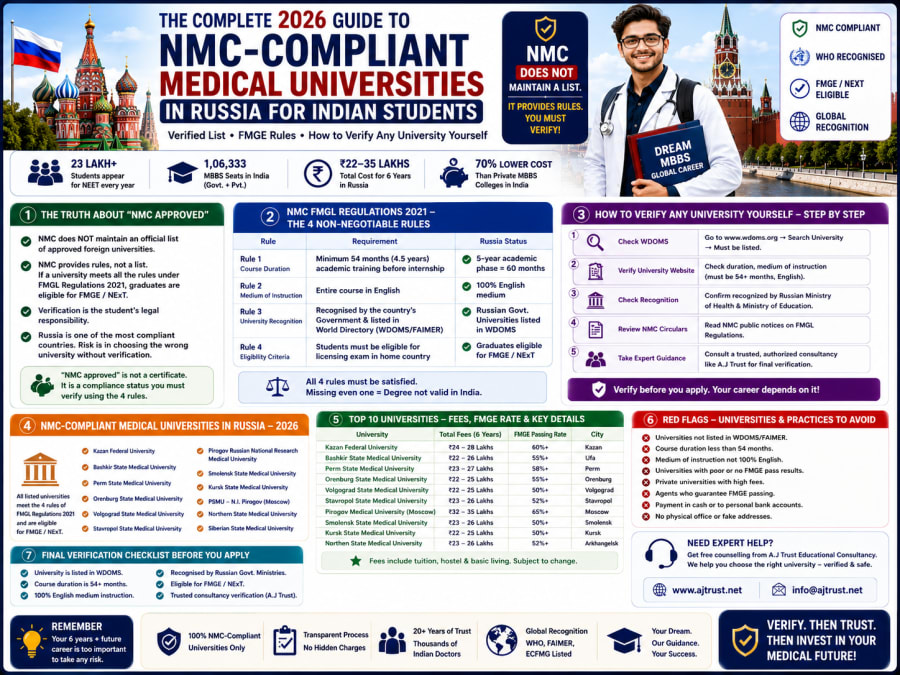
The number this whole comparison turns on. A Russian degree is usable in India only after you clear FMGE, and most candidates do not clear it: in the NBEMS 2024 report, 20,382 of 79,000 candidates passed — 25.80%. Russia-trained candidates did better than that average, 3,331 of 11,276 (29.54%), and the spread between universities is enormous: Orenburg passed 194 of 447 (43.4%) while Stavropol passed 132 of 719 (18.4%) in the same report. An Indian MBBS graduate faces no such exam. That is the real trade, and it is why the university you pick matters more than the country. Figures from the NBEMS institute-wise reports.
This is the most searched question — and the answer is yes, with conditions. Here is exactly how validity works for both:
- ›MBBS from India (Govt. or Private): Directly recognised by NMC. No extra licensing exam required to practise in India. NExT was meant to change that for everyone, Indian and foreign graduates alike, but NMC deferred it in July 2023 on the Health Ministry's advice and the deferral has not been lifted.
- ›MBBS from Russia: Valid in India — provided the degree meets the FMGL-2021 criteria and the university is listed in WDOMS. Compliance attaches to the degree you complete, not to the school, and NBEMS assesses it per candidate at FMGE registration. You must clear FMGE after graduation and then complete a 12-month supervised internship in India (our guide to the internship in India after MBBS abroad covers it). If NExT is ever brought into force it would apply to Indian and foreign graduates alike, which would level the field, but it stands deferred and no start date has been notified.
- ›Global validity: for the USA, ECFMG needs a Sponsor Note on the school's WDOMS entry covering your graduation year, so a WDOMS listing alone is not enough, and USMLE Step 3 comes only after ECFMG Certification. For the UK, the GMC must accept the degree before you sit PLAB: a WDOMS entry is necessary but not sufficient, and the GMC assesses seven Russian institutions case by case. Be precise about the words: WHO does not accredit medical schools at all and FAIMER approves nothing — it co-runs the WDOMS directory. Indian graduates go through the same ECFMG and GMC checks. Each route, with its sources, is in our career after MBBS in Russia guide.
Where NExT actually stands: NExT has not replaced FMGE. NMC public notice No.Cdn.19012/15/2022/Coord-NMC of 13 July 2023 deferred the National Exit Test on the Health Ministry's advice until further directions, that deferral has not been lifted, and on 18 October 2026 NMC's What's New list had no NExT notice later than 8 February 2024. No start date has been notified. Plan for FMGE and treat any specific NExT start year you see as a guess. If it were brought into force it would apply to Indian and foreign graduates alike.
Education Quality & Clinical Exposure — Russia vs India
- ›Infrastructure: Top Russian medical universities have introduced high-tech simulation centres, robotics, and modern labs for 2026-27. Indian government hospitals attached to medical colleges offer high patient volume — which is a clinical advantage. Indian private colleges vary widely in infrastructure quality.
- ›Clinical exposure: Russia offers excellent hospital training through large multi-speciality government hospitals from Year 3. The key challenge is that patient interaction happens in Russian — students who invest in learning the language get stronger clinical training. NMC's rule is a degree "with medium of instructions in English", and it has not ruled on courses taught partly in Russian. Our guide to English-medium MBBS in Russia covers what to get in writing. India naturally has an English/Hindi clinical environment with very high patient load.
- ›Class size & attention: Russian universities generally teach in small clinical groups, often 10–15 students, including hands-on cadaveric dissection. Many Indian private colleges have significantly larger batch sizes, diluting individual attention.
- ›Academic depth: Russian medical universities teach to the Russian federal state standard, which is theory-heavy in the early years. There is no "European curriculum standard" they are held to, and neither FAIMER nor WHO sets or certifies medical curricula. India's NMC curriculum is well-structured but more examination-focused at private colleges.
Career Scope After MBBS — Russia vs India Degree
| Career Path | Russia Graduate | India Graduate |
|---|---|---|
| Practice in India | Clear FMGE → 12-month supervised internship in India → State Medical Council registration | Direct registration; NExT if it is ever brought into force |
| PG in India (MD/MS) | FMGE pass, registration, and the internship in India finished by the session's cut-off, then NEET-PG (NExT is deferred, no start date notified) | NEET-PG (NExT is deferred, no start date notified) |
| Practice in USA | USMLE Step 1 and Step 2 CK if the school's ECFMG Sponsor Note covers your graduation year; Step 3 after ECFMG Certification | USMLE (needs ECFMG certification) |
| Practice in UK (the GMC must first accept the degree) | PLAB 1 + PLAB 2 → GMC registration | PLAB 1 + PLAB 2 → GMC registration |
| Middle East (UAE, Saudi Arabia) | Licence from the DHA, DOH Abu Dhabi or MOHAP under the shared PQR conditions, or from Saudi Arabia's SCFHS | Licensed by the same regulators |
| Average Starting Salary (India) | Varies widely by state and setting; ask us for current ranges | Varies widely by state and setting |
Important: NExT is not in force and NMC has notified no start date, so today the Russian graduate must clear FMGE and then complete a 12-month supervised internship in India, while the Indian graduate sits no licensing exam. That is the real gap to plan around. If NExT ever commences it would apply to all MBBS graduates, Indian and foreign, and a Russian graduate who clears it and completes the internship in India would have the same practice rights and PG eligibility as an Indian private college graduate — who paid 3–4x more for their degree.
Who Should Choose What — Honest Decision Framework
There is no universal answer. The right choice depends entirely on your NEET rank, budget, and career goals. Here is the clearest framework:
- ›Choose India (Govt. college) if: You have secured a government MBBS seat. Period. Government MBBS in India — lowest cost, direct NMC recognition, familiar environment, high patient volume clinical training. No debate here.
- ›Choose Russia if: You have qualified NEET but missed government college cutoff. You are comparing Russia against private MBBS in India. Russia saves you ₹50–80 lakhs, gives you zero donation burden and a degree from a WDOMS-listed university, and leaves you with FMGE to clear and a 12-month internship in India to complete on return.
- ›Choose India (Private college) if: Staying close to home is a priority, you have the budget without financial strain, and you prefer direct NMC recognition without an extra licensing exam. Be fully aware of what you are paying and why.
- ›Do NOT choose Russia if: You cannot commit to learning Russian for clinical communication. You are not prepared to seriously prepare for FMGE/NExT from Year 1. You are choosing Russia based only on the cheapest university without checking that its degree meets FMGL-2021.
Final Verdict — Russia vs India MBBS in 2026
Government MBBS in India > MBBS in Russia > Private MBBS in India. That is the honest ranking for most Indian students.
If you cannot get a government seat, Russia is the smarter financial decision by a significant margin. You save ₹50–80 lakhs compared to a private Indian college, and earn a degree from a WDOMS-listed university. The disadvantage that remains is real, though: you must clear FMGE, and roughly three in four candidates do not.
The only students Russia does not work for are those who are not serious about FMGE/NExT preparation, or those who choose a university without checking that its degree meets FMGL-2021. Choose the right university, start exam prep from Day 1, and Russia can be a sound medical career investment in 2026.
Share this article