Table of Contents
- MBBS in Russia 2026-27 — At a Glance
- Why Indian Students Choose Russia for MBBS
- Course Duration & Curriculum Structure
- MBBS Fees in Russia 2026-27
- Eligibility Criteria for Indian Students
- Step-by-Step Admission Process
- Documents Required
- Russian Universities Indian Students Choose Most
- Cost of Living & Student Life
- Career After MBBS in Russia — FMGE & NExT
Russia has been the most preferred destination for Indian medical students for over 30 years — and 2026-27 is no different. With government-subsidised tuition fees, a wide field of WDOMS-listed state universities, English-medium programmes, and a six-year all-in cost of about ₹21–53 lakh at the standard-tier universities, Russia continues to offer one of the strongest combinations of affordability and quality available to NEET-qualified Indian aspirants anywhere in the world.
Russia has one of the largest Indian medical-student populations abroad; the closest published measure is the FMGE candidate count — 11,276 Russia-trained candidates in the 2024 report alone. This guide covers everything you need for the 2026-27 intake — fees, top universities, eligibility, admission process, documents, living costs, and your FMGE/NExT pathway after graduation.
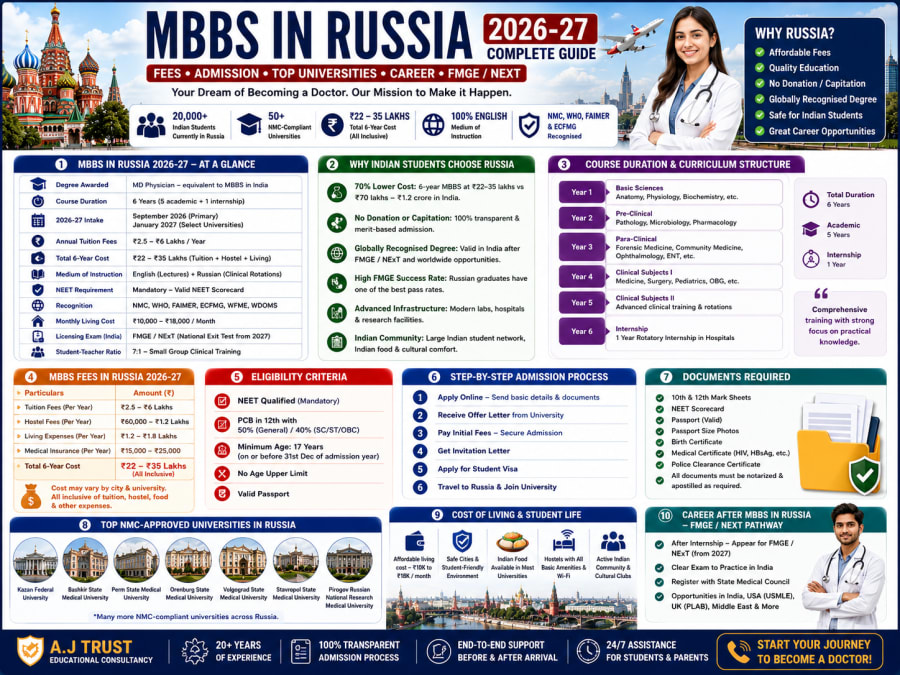
MBBS in Russia 2026-27 — At a Glance
| Degree Awarded | MD Physician — equivalent to MBBS in India |
| Course Duration | 6 Years (5 academic + 1 mandatory internship) |
| 2026-27 Intake | September 2026 (primary) | January 2027 (select universities) |
| Annual Tuition Fees | ₹2.2 – ₹7 Lakhs/year (university dependent) |
| Total 6-Year Cost | ₹21 – ₹53 Lakhs (tuition + hostel + living) |
| Medium of Instruction | English (lectures) + Russian (clinical rotations) |
| NEET Requirement | Mandatory — valid NEET scorecard required |
| Recognition | WDOMS-listed universities; the degree must meet the FMGL-2021 criteria, then FMGE |
| Monthly Living Cost | ₹11,500 – ₹17,200/month |
| Licensing Exam (India) | FMGE (NExT deferred, no start date notified) |
| Class sizes | Clinical teaching is done in small groups; ask each university for its current ratio in writing |
Why Indian Students Choose Russia for MBBS in 2026
NMC's seat matrix for 2026-27 lists 1,36,939 MBBS seats across 823 colleges, excluding the INIs such as AIIMS and JIPMER, of which 63,296 are government seats. NTA registered 22.79 lakh candidates for NEET UG 2026. Private college fees run from about ₹60 lakh to ₹1.5 crore for the full course, indicative only — the binding figure is the fee notified by each state Fee Regulatory Committee. Russia solves both problems at once: affordable fees and a globally recognised degree with no donation, no capitation. Here is why so many Indian students are there right now:
- ›Government-subsidised fees: annual tuition at the standard tier runs roughly ₹2.2 to ₹7 lakh, against ₹60 lakh to ₹1.5 crore for the whole course at a private Indian college. Fees are paid directly to the university.
- ›A degree the international routes recognise: a WDOMS-listed Russian degree is what ECFMG verifies before it lets you sit the USMLE, and the same listing underpins PLAB and AMC; for India the degree must meet the FMGL-2021 criteria and you must clear the FMGE. Note what these words do not mean: NMC approves no foreign university, WHO accredits no medical school, and FAIMER co-runs the WDOMS directory rather than approving anything.
- ›English-medium instruction, no IELTS or TOEFL needed: the universities Indian students go to run their MBBS in English. Confirm in writing that clinical rotations are in English too, not bilingual — that is an FMGL-2021 condition. Only your NEET scorecard is required. Russian language is taught as a subject for clinical communication.
- ›Extensive clinical exposure from Year 3: Students train in large government multi-speciality hospitals affiliated with universities. Small groups of 10–15 students ensure hands-on cadaveric dissection and one-on-one faculty attention.
- ›Modern infrastructure & simulation centres: For 2026-27, top Russian universities have introduced high-tech simulation centres and robotics in their curriculum — providing practical exposure comparable to Western standards.
- ›Strong India-Russia bilateral ties: Russia has welcomed Indian students since the pre-independence era. Active Indian Student Associations celebrate Diwali, Holi, and Independence Day on campus. Indian mess facilities are standard at most universities.
- ›Low cost of living: Monthly living expenses in Russia average ₹10,000–₹18,000 — roughly 58% lower than the USA and significantly lower than Western European countries.
- ›No donation, merit-based admission: All government Russian medical universities follow a transparent, merit-based admission process. Zero capitation fees — ever.
MBBS Course Duration & Curriculum Structure in Russia
The MBBS program in Russia spans 6 years across 12 semesters and is structured to comply with NMC FMGL Regulations 2021 — which require a minimum of 54 months of academic training plus 12 months of clinical internship.
| Phase | Years | Subjects Covered |
|---|---|---|
| Pre-Clinical / Basic Sciences | Years 1 – 2 | Anatomy, Physiology, Biochemistry, Histology |
| Para-Clinical Sciences | Years 3 – 4 | Pathology, Microbiology, Pharmacology, Forensic Medicine |
| Clinical Rotations | Years 4 – 5 | General Medicine, Surgery, Paediatrics, OB-GYN, Psychiatry |
| Mandatory Internship | Year 6 | Hospital-based clinical training at university-affiliated hospitals |
NMC compliance note: As per NMC FMGL Regulations 2021, the internship must be completed at a hospital affiliated with your university in Russia — it cannot be transferred to India. Confirm this with your chosen university before applying.
MBBS Fees in Russia 2026-27 — Complete Cost Breakdown
MBBS fees in Russia vary by university, city, and whether it is a government or private institution. Below is the full realistic cost breakdown for Indian students planning the 2026-27 intake — including tuition, hostel, living, and the hidden costs most consultants skip:
| Expense | Annual Cost | 6-Year Total |
|---|---|---|
| Tuition Fees | ₹2.2 – ₹7 Lakhs/yr | ₹13 – ₹41 Lakhs |
| Hostel / Accommodation | ₹30K – ₹80K/yr | ₹1.8 – ₹4.8 Lakhs |
| Food & Daily Living | ₹60K – ₹1.2 Lakhs/yr | ₹3.6 – ₹7.2 Lakhs |
| Medical Insurance | ₹10K – ₹20K/yr | ₹60K – ₹1.2 Lakhs |
| Russian Language Classes | ₹20K – ₹40K/yr | ₹60K – ₹1.2 Lakhs |
| Total Estimated Cost | — | ₹21 – ₹53 Lakhs |
Important: Always pay tuition fees directly to the university — never to a consultant's bank account. Fee structures are based on the previous academic year and are subject to exchange rate fluctuations. Contact your university directly for the confirmed 2026-27 fee breakdown.
Eligibility Criteria for MBBS in Russia — Indian Students 2026
- ›Academic qualification: Minimum 50% aggregate marks in Physics, Chemistry, and Biology (PCB) in Class 12th from a recognised board. 40% for SC/ST/OBC candidates, and 45% for general-category candidates with a benchmark disability.
- ›NEET mandatory: Valid NEET UG scorecard is compulsory — as per the NMC mandate in effect since 2018. NEET score is valid for 3 years for abroad admissions. Without NEET, you cannot appear for FMGE or NExT after graduation.
- ›Age requirement: Minimum 17 years as of 31st December of the admission year. No strict upper age limit at most Russian universities.
- ›Valid passport: Minimum 18 months validity at the time of visa application.
- ›No IELTS or TOEFL: not required by Russian medical universities for Indian students.
- ›An FMGL-2021 compliant course: the course you enrol on must meet the FMGL-2021 criteria — 54 months of study, a 12-month internship at the same institution, English medium, and a qualification licensing you to practise in that country — and the university must be listed in WDOMS. Compliance attaches to the degree, not the school, so verify it for the specific course before paying any fee.
Step-by-Step Admission Process for MBBS in Russia 2026-27
- ›Step 1 — Shortlist universities: compare on FMGE pass rate, annual fees, city, hostel quality, hospital affiliation and Indian student community, and check that the course meets the FMGL-2021 criteria. Verify the WDOMS listing independently.
- ›Step 2 — Submit provisional application (Jan–Mar 2026): Fill the application form with Class 10/12 marksheets, passport copy, photographs, and NEET scorecard. Apply before NEET results — provisional applications are accepted.
- ›Step 3 — Receive admission / offer letter: University reviews your application and issues a conditional admission letter. This is not the final document — it is a holding confirmation.
- ›Step 4 — Submit NEET scorecard & get final admission letter (May–Jun 2026): Once NEET results are declared, submit your scorecard immediately. The university issues the Final Admission Letter — required for visa processing.
- ›Step 5 — Receive official invitation letter (Jun–Aug 2026): The university coordinates with Russia's Ministry of Education to issue the official Invitation Letter — the key document for your student visa application.
- ›Step 6 — Apply for Russian student visa: Submit your invitation letter, passport, HIV report, medical certificate, and other embassy documents. Visa processing takes 3–6 weeks — start immediately upon receiving the invitation letter.
- ›Step 7 — Pay first-year tuition & travel to Russia (Aug 2026): Pay tuition directly to the university. Book flights, arrange forex and travel insurance, and prepare for pre-departure orientation.
- ›Step 8 — University registration & classes begin (Sep–Oct 2026): On arrival, complete hostel check-in, sign university and hostel contracts, complete biometric registration, medical checkup, visa extension, SIM card, and insurance formalities.
Documents Required for MBBS in Russia 2026-27
| Document Type | Documents Required |
|---|---|
| Academic Documents | Class 10th marksheet, Class 12th marksheet & pass certificate, NEET UG scorecard |
| Identity Documents | Valid Indian passport (min. 18-month validity), birth certificate, Aadhaar card copy |
| Photographs | 6–10 passport-size photos (white background, 70% face, size 3.5 × 4.5 cm) |
| Medical Documents | Medical fitness certificate, HIV negative test report (mandatory before visa stamping) |
| Admission Documents | Official invitation letter from the Russian university (issued by Ministry of Education) |
| Financial Documents | Bank statements, travel insurance, air tickets |
Russian Medical Universities Indian Students Choose Most, 2026-27
Russia has many state medical universities admitting Indian students, and a large share of them teach international students in English. Compliance is decided per degree against the FMGL-2021 criteria, not per university by any authority, so treat the list below as where students commonly go rather than as a clearance. Each row carries the university's own NBEMS record:
| University | City | FMGE record and what it is known for |
|---|---|---|
| Kazan State Medical University | Kazan | Founded 1814; one of Russia's older medical schools. FMGE 2024: 134 of 436 (30.7%); 2025: 107 of 387 (27.6%) |
| Perm State Medical University | Perm | Large Indian intake and a cohort big enough for its rate to mean something. FMGE 2024: 295 of 944 (31.2%); 2025: 201 of 826 (24.3%) |
| Orenburg State Medical University | Orenburg | The strongest record of the Russian universities we track. FMGE 2024: 194 of 447 (43.4%); 2025: 180 of 467 (38.5%) |
| Volgograd State Medical University | Volgograd | Affordable, with an established Indian community. FMGE 2024: 113 of 586 (19.3%); 2025: 66 of 467 (14.1%) |
| Stavropol State Medical University | Stavropol | Southern Russia, warmer climate. FMGE 2024: 132 of 719 (18.4%); 2025: 87 of 722 (12.1%) — plan coaching from Year 1 |
| Tver State Medical University | Tver | Close to Moscow. FMGE 2024: 118 of 484 (24.4%), but 2025 fell to 32 of 337 (9.5%) — ask the university why |
| I.M. Sechenov First Moscow State Medical University | Moscow | The best-known Russian medical university internationally, and the most expensive here. Its Indian cohort is small: FMGE 2024: 12 of 54 (22.2%); 2025: 8 of 59 (13.6%) |
| Bashkir State Medical University | Ufa | Strong research and infrastructure. FMGE 2024: 105 of 340 (30.9%); 2025: 70 of 296 (23.6%) |
FMGE figures read passed of appeared, from the NBEMS institute-wise performance reports. For context, the national average across all countries in 2024 was 20,382 of 79,000 (25.80%), and Russia as a whole passed 3,331 of 11,276 (29.54%). A rate describes the cohort that sat the exam six or more years after enrolling, repeat attempts included.
Verify before you enrol: Always confirm your chosen university and specific program are listed in the World Directory of Medical Schools (WDOMS) and comply with NMC FMGL Regulations 2021. NMC no longer publishes a fixed approved list. Never pay fees based on a consultant's verbal confirmation alone.
Cost of Living & Student Life in Russia 2026
| Expense | Monthly Cost |
|---|---|
| Food (hostel mess / self-cooking) | ₹8,000 – ₹12,000 |
| Local transport (metro / bus) | ₹800 – ₹1,200 |
| Mobile & internet | ₹700 – ₹1,000 |
| Personal & miscellaneous | ₹2,000 – ₹3,000 |
| Total monthly living | ₹11,500 – ₹17,200 |
- ›Hostel facilities: Separate hostels for boys and girls with AC, water heaters, purifiers, laundry, study tables, and 24/7 security. Most universities have dedicated Indian mess serving North and South Indian cuisine.
- ›Indian food: Easily available in Russian cities — Indian restaurants, Indian grocery stores, and university canteens with Indian food options are present near most major medical universities.
- ›Climate: Winters are harsh — temperatures drop to -15°C to -25°C in cities like Perm, Orenburg, and Kazan. Pack for extreme cold. Stavropol in southern Russia has a milder climate and is popular for this reason.
- ›Safety: Russian university campuses have structured security. Indian Student Associations are active across all major cities — providing peer support from Day 1.
Career After MBBS in Russia — FMGE, NExT & Global Options
Completing MBBS from Russia gives you multiple career pathways — in India and internationally. Here is what you can pursue after graduation:
- ›Practice in India — clear FMGE or NExT: All foreign medical graduates must clear the FMGE to obtain an Indian medical licence. NExT is deferred and no start date has been notified. Russian university graduates recorded 3,331 passes from 11,276 candidates in the NBEMS 2024 report, which is 29.54%, and individual universities range from single digits to well above that — read the per-university figures rather than a national band. Start FMGE prep from Year 1.
- ›Postgraduate studies in India — NEET-PG today: the PG route for a foreign graduate is to clear FMGE, complete the 12-month Indian internship, register with a State Medical Council and then sit NEET-PG. NExT has not replaced FMGE. NMC public notice No.Cdn.19012/15/2022/Coord-NMC of 13 July 2023 deferred the National Exit Test on the Health Ministry's advice until further directions, that deferral has not been lifted, and NMC has since indicated a further three-to-four-year delay. Plan for FMGE and treat any specific NExT start year you see as a guess.
- ›Practice in USA — USMLE: Russian medical degrees from ECFMG-recognised universities are eligible for USMLE Steps 1, 2, and 3 — the pathway to residency and practice in the United States.
- ›Practice in UK — PLAB: Pass PLAB 1 and PLAB 2 exams administered by the GMC to obtain registration and practice in the United Kingdom.
- ›Practice in Middle East & CIS countries: Russian medical degrees are widely recognised across CIS nations, the Middle East, and parts of Asia — offering strong regional career opportunities.
Key tip: Choose a university that provides structured FMGE/NExT coaching throughout the course — not just in the final year. Students who integrate exam prep from Year 1 consistently outperform those who start late. Ask your consultancy for proof of the university's FMGE pass rate before you apply.
Is MBBS in Russia Worth It in 2026-27?
Yes — for the right student. If you are NEET-qualified, want a globally recognised medical degree at 70% lower cost than Indian private colleges, and are prepared to learn Russian for clinical communication, Russia is one of the best MBBS abroad decisions you can make in 2026.
The key is making informed choices: pick an NMC-compliant, WDOMS-listed university with a strong FMGE pass rate, verify all fees directly with the university, start FMGE/NExT prep from Day 1, and work with a transparent consultancy that shows you real numbers — not just first-year tuition figures.
Admissions for the September 2026 intake are open now. Top university seats fill fast — do not wait for NEET results to begin your application.
Share this article